







Introduction:Keemun Gongfu Black Tea is a renowned traditional Chinese tea, and its unique production techniques and flavor variations have garnered significant attention among tea enthusiasts. This article delves into the entire process from tea garden plucking to drying and smoking, offering a detailed comparison of the taste and aroma differences between smoked and non-smoked Keemun. It also shares firsthand procurement challenges and insights, helping readers gain a more comprehensive understanding of the charm of this classic black tea.
As one of China’s traditional famous teas, Keemun Gongfu Black Tea has long been a focal point for tea lovers due to its refined production techniques and diverse flavors. Through on-site visits, this article fully documents each step—from tea garden picking and manual refining to drying and smoking processes—and provides an in-depth comparison of the aroma and taste differences between smoked and non-smoked Keemun, taking you deeper into the production mysteries of this classic black tea.
On the way to the tea region, I took a several-hour-long bus ride to a remote mountain village. A local friend who grew up there kindly served as my guide, taking me to visit tea gardens and processing workshops. During this journey, I witnessed firsthand the transformation of Keemun from fresh leaves to finished product and gained a deeper understanding of its intricate craftsmanship.
In the early morning tea gardens, tea pickers bring back basket after basket of freshly plucked tender leaves. These fresh leaves are small and delicate, usually carried in bamboo baskets. Around the village market, many buyers are already waiting, carefully inspecting each batch of fresh leaves and negotiating prices based on leaf size and quality. Generally, the smaller and more uniform the leaves, the more likely they are from the tea plant’s tenderest buds, making them suitable for high-grade black tea and thus commanding a higher price.
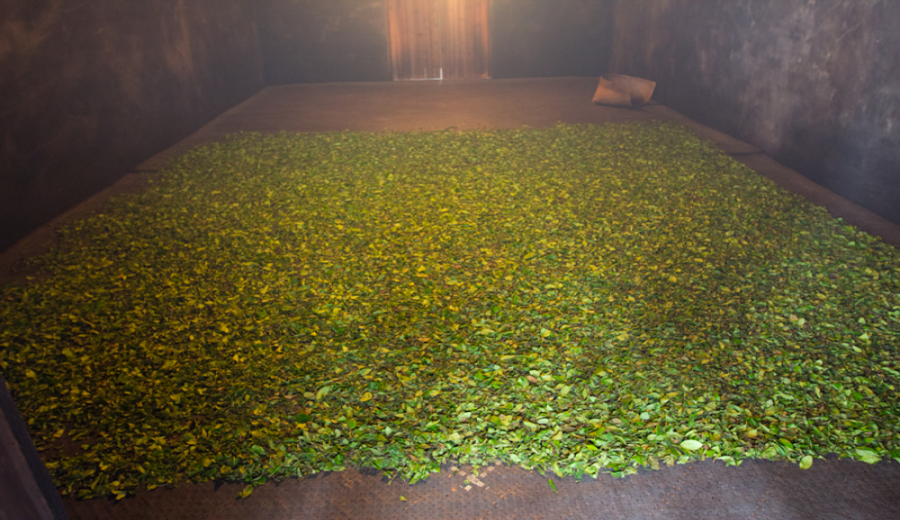
In the afternoon, tea farmers purchase the day’s freshly picked leaves from the buyers, allowing them to undergo a full night of natural oxidation and fermentation. The next day, these leaves proceed to the next steps of shaping and drying. The most tender leaves are usually hand-shaped in a wok—a highly experience- and skill-intensive process that is time-consuming and demands exceptional craftsmanship—while larger or mid-to-lower grade leaves are often machine-shaped to improve efficiency.
Based on appearance, Keemun Black Tea can generally be divided into three main types:Keemun, characterized by its slender, straight, and tightly rolled leaves;Mao Feng, which has a flatter and more compact shape; andXiang Luo, with leaves that are distinctly curled. Interestingly, the local definitions and distinctions between Keemun and Mao Feng are not clearly delineated—many tea farmers can’t even clearly explain the difference, only able to distinguish them slightly by leaf size, with Mao Feng generally considered to have slightly larger leaves.
In terms of drying, Keemun can be processed using either a drying oven or traditional bamboo basket smoking. Keemun dried in a drying oven typically yields a tea liquor with a fresh and crisp flavor, featuring distinct citrus fruit aromas, making it suitable for those who prefer lighter-tasting tea. In contrast, bamboo basket-smoked Keemun follows a more traditional method, where the tea leaves acquire a subtle smoky aroma and a richer, deeper taste. Notably, this smoky flavor is not harsh but naturally blends with the tea’s inherent aromas, creating a unique layered profile. If you prefer a bolder flavor, go for the smoked version.
During this visit, I had the chance to taste dozens of Keemun teas from various tea factories and family workshops. Most of these teas come from the same tea region and are made from tender leaves, all processed entirely by hand. It’s particularly worth noting that the production process for smoked Keemun is more stringent—the bamboo basket can only handle about 250 grams of fresh leaves at a time, whereas the drying oven can dry several kilograms in a single batch. As a result, the majority of Keemun products on the market are not smoked. If you want to try the smoked flavor, be sure to specifically request it, and it’s recommended to specify a smoking time of 45 minutes rather than the more common 30 minutes to achieve a richer smoky aroma.
Through personal tasting, I found that Keemun from the same tea garden, same harvest batch, and made by the same tea farmer can exhibit completely different flavor profiles simply due to the final drying method (smoked vs. non-smoked). This difference is astonishing and gives a deeper appreciation of how crucial the production process is to the final flavor.
Additionally, I observed the production processes of other green tea varieties, but the Keemun Gongfu Black Tea process particularly fascinated me. During drying, the tea leaves are placed over a large amount of embers to roast, similar to meat on a large grill. The grill is set at a slight incline and slowly rocked back and forth, allowing the leaves to gradually slide from one end to the other during heating, which helps control the degree of oxidation. The final step involves placing the leaves in a large drying oven for thorough drying. This step differs from electric oven methods and better preserves the tea’s original aroma and complexity.
During this trip, due to the cold weather, my usual supplier hadn’t yet received the new tea, so I had to visit multiple tea shops to find a suitable alternative. Although the quality remained excellent, the prices were noticeably higher. Moreover, due to exchange rate fluctuations and rising prices, compared to the previous year, the Chinese yuan had appreciated over 30% against the euro. Even with unchanged prices, this season’s Keemun tea from Nanshan was about 30% more expensive. Coupled with the overall rise in prices within China, procurement costs increased further. However, it’s worth mentioning that several Keemun Black Tea products launched by this brand this season still maintained a high cost-performance ratio, offering tea enthusiasts more diverse choices.
The above content is compiled by CoffeeHunters, a coffee news website.


