







Introduction:Recently, a case in which a man staged putting insects in a well-known milk tea shop and extorted money from it has drawn public attention. This case not only reveals some loopholes in food hygiene management at certain tea beverage outlets, but also raises public doubts about the authenticity of food safety complaints. This article delves into the entire process of the incident, explores how the tea beverage industry can face trust crises, and provides practical suggestions for both consumers and businesses.
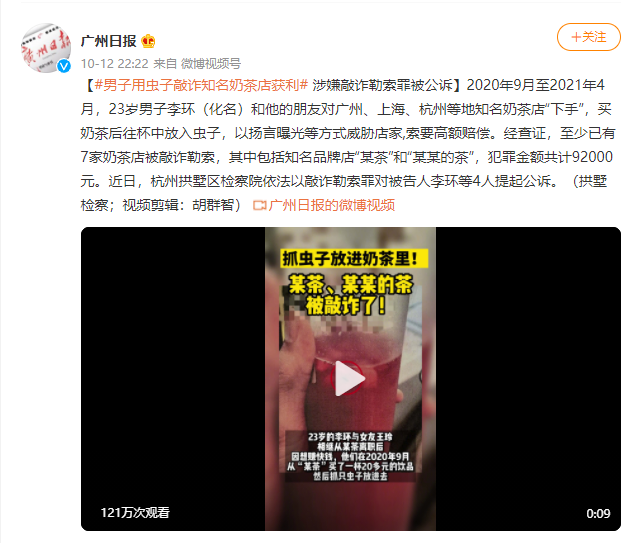
In recent years, the tea beverage industry has frequently been hit by food safety incidents, from well-known brands being found to have "real spiders" in their drinks to issues such as the use of expired ingredients, often becoming the focus of public opinion. However, a news story in October 2023 showed that some so-called "food safety incidents" may have other hidden motives behind them. A case reported by the Guangzhou Daily revealed that a 23-year-old man, using his experience working at a tea beverage shop, conspired with his girlfriend and friends to deliberately place insects in drinks from some well-known milk tea brands and extort large sums of money under the pretext of food safety, with the amounts involved ranging from several thousand yuan to as much as two hundred thousand yuan.
It is understood that the man had worked for a well-known tea beverage brand in 2020, during which time he became familiar with store operation procedures and internal management methods. After leaving the job due to loss of stable income, he began to devise a devious plan, creating a set of "staged accident" tactics. At the end of September 2020, the man and his girlfriend bought a drink worth about 20 yuan or so at a branch in Hangzhou, deliberately caught a small insect in a nearby park, put it into the drink, and took photos and videos as evidence, then immediately made a compensation claim to the store.
Initially, the man "taught" his girlfriend to demand compensation of 1,000 yuan from the merchant based on food safety regulations, but ultimately succeeded in extorting 45,000 yuan on the grounds of "affecting brand reputation." After the initial success, the group became even more brazen. Half a month later, they targeted a branch of "XX Tea" in Hangzhou, but after only making 1,000 yuan, they quickly returned to the brand they were originally familiar with.
From the end of November 2020 to early April 2021, the man and his accomplices repeatedly used the same trick at branches in Dongguan, Shenzhen, Guangzhou, and other places, including one instance where they demanded as much as 200,000 yuan in compensation from the store. Their modus operandi mostly involved secretly putting insects into cups after purchasing drinks, then creating the false appearance of a so-called "food safety issue" through taking photos and videos, and subsequently threatening the store that if they did not compensate, they would expose the video and damage the brand's reputation.
At the end of April 2021, the group moved to Shanghai, planning to target a well-known milk tea store again. However, because several similar cases had previously raised the headquarters' alertness, the incident was quickly reported, and the headquarters immediately contacted the police to investigate. Eventually, this series of planned extortion activities was uncovered. This case also led the outside world to re-examine how the tea beverage industry handles consumer complaints, and how to protect consumer rights while avoiding being exploited by those with ulterior motives.
After the case was exposed, netizens expressed shock on social platforms, and many also recalled a previous incident where a "big spider" was found in a drink from a certain brand, suspecting that it might also be a similar human operation. Some netizens commented that although it sounds unbelievable, in the busy environment of a store, if employees do not carefully check the drinks, it is indeed possible for foreign objects to accidentally get mixed in before sealing, but it is also not ruled out that someone deliberately exploited the loophole.
This incident not only highlights the lack of basic hygiene management and employee training in some tea beverage brands despite their expansion, but also reflects that in the current consumption environment, some people take advantage of merchants' sensitivity to food safety issues in an attempt to profit from it, forming a vicious cycle. If merchants choose to settle matters quietly for fear of damaging their reputation, it may instead encourage such behavior; and if consumers adopt a skeptical attitude towards every complaint, it will also undermine the foundation of market trust.
For ordinary consumers, the hygiene and deliciousness of drinks are the most basic requirements, rather than obtaining high compensation through complaints. Merchants should also establish a more comprehensive food safety management mechanism, including increasing the transparency of the drink preparation process, enhancing employees' vigilance against foreign objects, and when facing complaints, investigating and handling them according to reasonable procedures, rather than simply compromising. Only by jointly maintaining a good consumption environment can both parties truly promote the sustainable development of the tea beverage industry.
The above content is compiled by CoffeeHunters, a coffee news website.


