







Introduction:Honey Orchid Phoenix Dancong Oolong Tea is famed for its distinctive honey-orchid floral aroma, but the tea plant variety and its production possibilities often cause confusion. This article delves into the Phoenix Dancong tea plant family to which Honey Orchid belongs, clarifies whether the White Leaf Variety is suitable for making black tea, and details its terroir characteristics, dry leaf appearance, liquor flavor, and optimal brewing methods — helping tea enthusiasts better appreciate the charm and craftsmanship behind this classic oolong tea.
Honey Orchid Phoenix Dancong Oolong Tea is one of the representative single-bush teas unique to the Phoenix Mountain area in Chaozhou, Guangdong. It is widely loved for its prominent honey-sweet aroma and orchid-like nuances. Beyond its distinctive flavor, the tea plant variety and production techniques behind this tea also involve considerable expertise. Many tea drinkers often wonder: what kind of tea plant variety does Honey Orchid actually belong to? Moreover, can the commonly mentioned White Leaf Variety be used to make black tea?
Honey Orchid Phoenix Dancong belongs to the Phoenix Dancong tea category — a semi-fermented oolong tea produced in the Phoenix Mountain area of Chaozhou, Guangdong. Its most defining feature is “single-bush plucking and processing, with distinct individual character.” The liquor of Honey Orchid often carries a rich honey undertone and an elegant orchid floral aroma, with a mellow taste and notable after-sweetness, hence the name “Honey Orchid.” These aromatic characteristics are closely related to the specific tea plant variety used.
In terms of tea plant variety, Honey Orchid primarily uses the local “White Leaf Variety.” It’s important to note that this “White Leaf Variety” does not refer to tea leaves that are white in color, but rather is named for its relatively light-colored leaves, which show a slight silvery-white sheen when the buds and leaves unfurl. This variety grows in the high-altitude mountainous regions of Phoenix Mountain, with tea trees typically ranging from 20 to 80 years old. It is a semi-arboreal small- to medium-leaf variety, with relatively broad leaves. Once processed into dry tea, the color tends to be dark brown, and when the leaf bottom unfurls, the green tone is less apparent, leaning more toward brown hues.
Regarding whether the White Leaf Variety can be used to make black tea, the answer is yes, but it is not common. Essentially, the White Leaf Variety is suited for oolong tea production, and its internal component ratios (such as tea polyphenols, amino acids, etc.) are more appropriate for semi-fermented tea. If used for black tea, although it can technically be fully oxidized, the resulting flavor often lacks the rich fruity or sweet notes typical of traditional black tea, and may instead highlight grassy or overly light characteristics. Therefore, the White Leaf Variety is generally still used for oolong tea production, especially for single-bush teas like Honey Orchid, which emphasize layered aromatics and lingering sweetness.
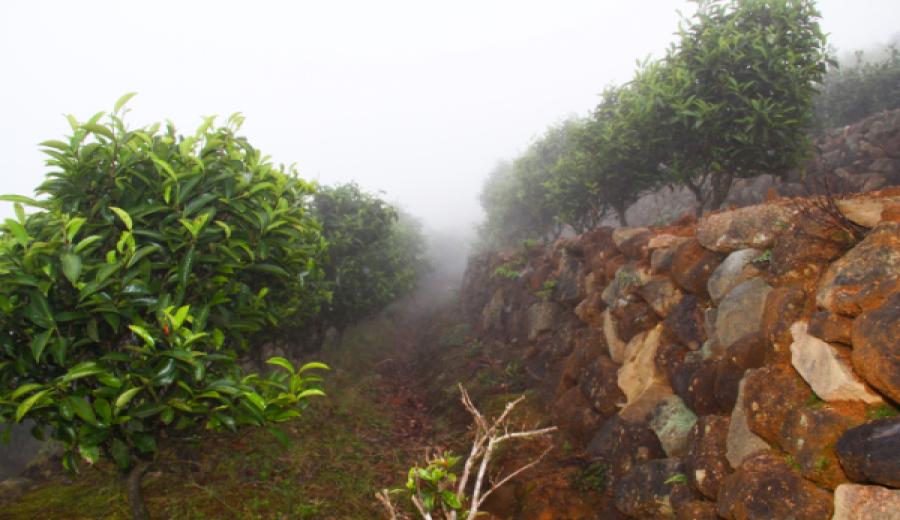
Geographically, Honey Orchid Phoenix Dancong is mainly concentrated in the Phoenix Mountain area of Chaozhou and surrounding mountainous regions, particularly in the Wudong Mountain range of the central mountain area. The tea trees are mostly planted at high altitudes between 800 and 1200 meters on steep slopes, where large diurnal temperature variations and abundant fog help develop rich aromatic compounds and a full-bodied flavor in the tea leaves. Tea farmers typically select old bush tea trees aged 20 to 80 years for picking. These trees have well-established root systems and strong nutrient absorption capabilities, producing tea leaves with deeper, more nuanced aromas.
In appearance, Honey Orchid Phoenix Dancong tea leaves are slender and intact, mostly processed using traditional hand-rolling techniques, resulting in tightly twisted leaves with natural curves. The dry tea color is偏向深棕, indicating moderate roasting. Roasting not only helps stabilize the aroma but also enhances the liquor’s body and sweetness.
In terms of liquor characteristics, the first and second infusions of Honey Orchid often present a copper-toned fruity aroma base, which gradually transitions into pronounced honey sweetness and elegant orchid floral notes. Some tea drinkers can even detect sweet nuances reminiscent of lychee. The liquor feels smooth on the palate, with rich layers and a long-lasting finish, making it suitable for multiple infusions — especially with the third to fifth infusions representing the peak of flavor expression.
For brewing recommendations, to fully showcase Honey Orchid’s aroma and mellow mouthfeel, it is advised to use a Yixing clay teapot or porcelainware, which helps concentrate the aroma and deliver a smoother cup. Before brewing, preheat your teaware with hot water to enhance overall brewing stability. It is recommended to use 2 to 5 grams of dry tea per 225 ml of water. The first two infusions should be brewed with 95°C water for about 1 minute, and subsequent infusions can have their steeping time extended gradually to 1 minute 30 seconds to 2 minutes, depending on the strength of the liquor, to fully release the tea’s inner qualities.
In summary, Honey Orchid Phoenix Dancong Oolong Tea is not only a tea with a unique aroma and mellow taste, but the White Leaf Variety tea plant used and its refined processing techniques also embody the cultural essence of Phoenix Mountain oolong tea. As for whether the White Leaf Variety can be used to make black tea — while technically possible, its flavor performance is not as outstanding as in oolong tea, so it is more recommended for crafting highly aromatic, sweet-returning oolong teas. Understanding these details not only helps tea enthusiasts choose teas that suit their preferences, but also allows for a deeper appreciation of the craftsmanship and natural gifts behind every cup.
The above content is compiled by CoffeeHunters, a coffee news website.


