







Introduction:There is a wide variety of black teas, ranging from ‘Lapsang Souchong’ with its distinctive smoky pine aroma, to ‘Congou black tea’ with its fine, tightly rolled leaves, to ‘broken black tea,’ which is suitable for quick brewing and commonly found in milk tea. These three types of black tea not only differ greatly in processing methods, but also in flavor profiles and suitable drinking occasions. This article delves into their origins, production differences, characteristics, and recommended ways to enjoy them, helping you understand the diverse world of tea through a single cup of black tea.
The world of black tea is rich and varied. According to the Chinese tea classification system, it can generally be divided into three main categories: Lapsang Souchong, Congou black tea, and broken black tea. Each category has its own unique regional background, tea-making craftsmanship, and flavor characteristics. A deeper understanding of these differences not only helps us better appreciate black tea, but also enables us to make more suitable choices when purchasing or brewing.
Lapsang Souchong: The Origin of Smoky Aroma
Lapsang Souchong is one of the earliest types of black tea to appear, originating in Fujian, China, with the Tongmu Pass area of Wuyi Mountain as its core production region. Its most distinctive feature is the use of pine wood open flames during the drying process, which imparts a unique smoky pine aroma to the tea leaves. This aroma has also become the most representative flavor hallmark of Zhengshan Xiaozhong.
The production region of Zhengshan Xiaozhong is limited to Tongmu Pass and Xincun, both high-altitude tea areas with limited output. As a result, many products on the market that claim to be ‘Zhengshan Xiaozhong’ may actually be ‘Waishan Xiaozhong’—black tea produced in surrounding areas of Wuyi Mountain such as Tanyang, Zhenghe, Pingnan, and Gutian. In addition, ‘smoked black tea’ is often made from the coarser leaves of Congou black tea, which are then smoked, resulting in a stronger aroma but a relatively lower grade.
Zhengshan Xiaozhong is characterized by its dark, glossy black leaves with tightly rolled and robust strips. The tea liquor is deep red, bright, and intense in flavor, with a lively taste and a distinct sweet aftertaste, reminiscent of longan soup—a quality that contributes to its popularity.
Congou Black Tea: Fine Strips and International Reputation
Congou black tea is an important type of traditional Chinese export tea, named for the ‘skill and effort’ (‘gongfu’) involved in its production. The tea leaves are tightly and evenly rolled, with a dark, glossy, and oily appearance, showcasing a high level of craftsmanship. Its production regions span more than ten provinces and regions in China, including Anhui, Yunnan, Fujian, Guangdong, Jiangxi, and Hubei, forming a diverse array of locally distinctive varieties.
Well-known Congou black teas include Qimen Congou (Anhui), Dian Hong (Yunnan), Yingde Black Tea (Guangdong), Min Hong (Fujian), Ning Hong (Jiangxi), and Yi Hong (Hubei). These teas are mostly made from tender buds and leaves, with complex and meticulous production processes, including withering, rolling, fermentation, and drying—each step influencing the final aroma and flavor.
Congou black tea features tightly rolled, uniform strips, a bright red and shiny liquor, a rich and lasting aroma, a mellow and sweet taste, and uniformly red and bright leaf bases. It is considered by many tea enthusiasts as the archetype of what black tea ‘should look like.’ With both appealing appearance and high internal quality, it has been a staple in traditional export markets and is widely favored by consumers in Europe and Asia.
Broken Black Tea: Quick Extraction and Milk Tea Favorite
The biggest difference between broken black tea and the previous two types lies in the ‘cutting’ step during processing. The tea leaves are mechanically rolled and cut into various sizes of granules or fragments, facilitating the rapid release of tea juice. It is an extremely efficient type of tea for brewing, especially when paired with milk and sugar to make milk tea, as it quickly delivers a strong flavor—making it a common base in international markets, particularly in British afternoon tea culture.
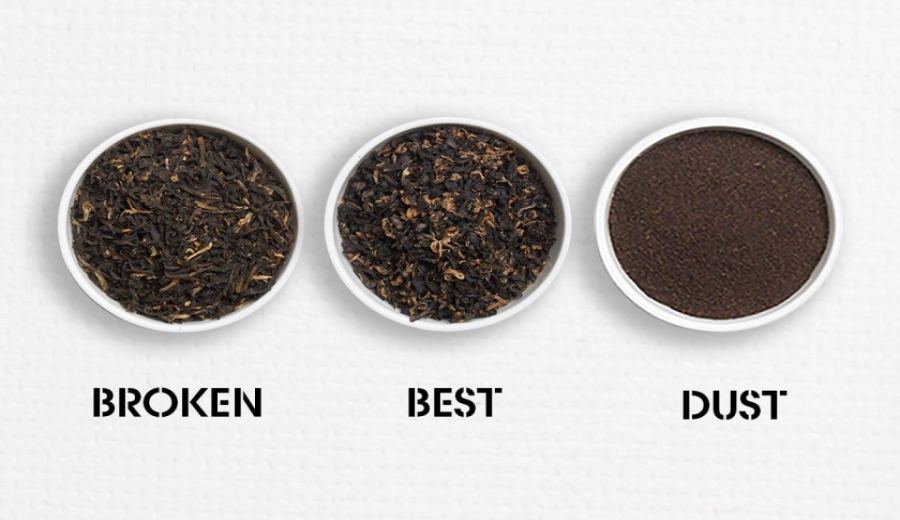
Broken black tea is further categorized by leaf shape into leaf tea (e.g., OP, FOP), broken tea (e.g., BOP, FBOP), fannings (e.g., BOPF, F), and dust (D). Among these, CTC (Crush, Tear, Curl) broken black tea, which has been mass-produced since the 1960s, represents a modern and iconic processing method. It produces a highly concentrated tea liquor with fast extraction, making it ideal for flavored beverages.
Broken black tea from large-leaf varieties (such as Assam in India or certain African tea regions) typically has a strong, intense flavor with a bright red liquor and high aroma. In contrast, those from small- to medium-leaf varieties (such as some Southeast Asian and southern Chinese tea regions) tend to have a milder, fresher taste and aroma, catering to different taste preferences.
Understanding the processing methods and characteristics of these three major types of black tea not only allows tea enthusiasts to choose suitable varieties based on personal preference, but also enables them to more subtly appreciate the flavor layers brought by different regions and production methods, thereby enhancing the enjoyment and depth of black tea tasting.
The above content is compiled by CoffeeHunters, a coffee news website.


