








Introduction:Both cold drip and cold brew are beloved methods of cold coffee preparation, yet they differ significantly in their brewing processes, required time, and final flavor profiles. This article delves into their specific brewing methods, key parameter settings, and the distinct differences in taste layers to help you choose the most suitable cold coffee method based on your preference.
Both cold drip coffee and cold brew coffee belong to the category of low-temperature, long-duration extraction methods. They not only preserve the original flavors of the coffee but also become popular summer choices due to their refreshing characteristics. However, many coffee enthusiasts often wonder what exactly sets the two apart when tasting them. From equipment used and brewing time to the nuanced changes in flavor layers, this article will thoroughly dissect the practical differences between the two cold brewing methods.
Firstly, although the brewing principles of both are similar — using cold water to extract coffee grounds over an extended period — their actual operation procedures are quite different.Cold Drip CoffeeIt mainly relies on a cold drip brewer, which consists of three parts: the top chamber, the middle chamber, and the bottom chamber. The top chamber holds an ice-water mixture, from which water drips very slowly onto the coffee grounds in the middle chamber to extract the flavors, eventually dripping into the bottom chamber to collect the coffee liquid. The entire process usually takes about6 to 8 hours, allowing the coffee to slowly release its flavors at a low temperature.

WhereasCold Brew Coffeeinvolves mixing pre-ground coffee with cold or ice water, then placing the entire mixture in a sealed container and letting it steep in the refrigerator. The generally recommended brewing time is12 to 24 hours. Once the time is up, simply filter out the coffee grounds with paper filters to obtain the final product. This method does not require special equipment—just a sealable container—and is more suitable for home brewing.
To clearly compare the actual performance of the two methods, you can use the same coffee beans for a comparative experiment. For example, selecting a coffee bean with distinct fruity aromas and sweet-tart notes, such as a natural-processed Huakui, allows for a more intuitive experience of the flavor differences between the two. In terms of grind size, it is recommended to use afine grind, with a benchmark of about75% passing through a #20 sieve , or adjust the grinder (such as an EK43s) to setting 9, or a hand grinder like a C40 to around 22 clicks.
For thecold drip coffeemethod, you can use60 grams of coffee grounds to 600 milliliters of coffee liquid, which equates to a coffee-to-water ratio of1:10. The dripping speed is recommended to be controlled at about 6 drops per 10 seconds, using an ice-water mixture as the water source to maintain a low temperature during extraction. The entire dripping process takes approximately7 to 8 hours. After extraction, it’s advised to pour the coffee liquid into a sealed bottle and let it sit in the refrigerator for48 hours, which helps further integrate the flavors.
As forcold brew coffee, it is recommended to use50 grams of coffee grounds, along with a total of600 milliliters of ice-water mixture(including 400 milliliters of cool water and 200 grams of hard ice), maintaining the same coffee-to-water ratio of1:10. Stir well, seal, and refrigerate for about24 hours. After extraction, carefully filter out the coffee grounds with paper filters, then transfer the coffee liquid into a clean, sealed bottle. It’s suggested to refrigerate it for another2 to 4 hoursto achieve a smoother and fuller mouthfeel.
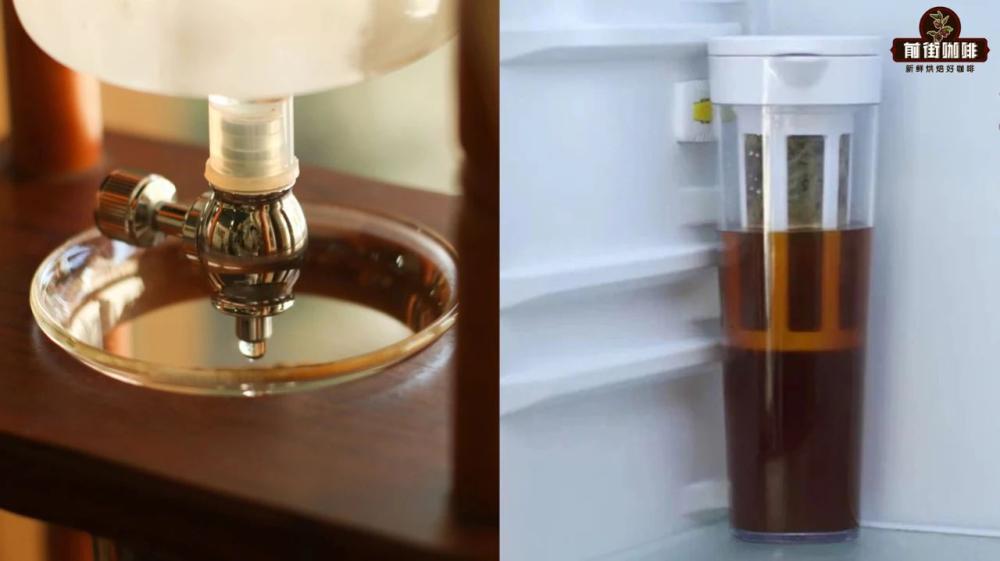
In terms of the final product’s visual and taste presentation, there are also notable differences. Cold drip coffee typically exhibits aclear and brightcolor, with a clean and refreshing taste that carries distinct fermentation notes and a slight wine-like aroma, along with gentle berry-like sweet-tart sensations. On the other hand, cold brew coffee, due to its longer steeping time, features a morerich and uniformflavor, with a fuller body and prominent fruit sweetness, though the fermentation character is relatively less pronounced, resulting in an overall rounder profile.
Additionally, the two methods differ in terms of crema/oil presence: cold drip coffee usually shows fewer floating oils, giving it a visually clearer appearance, whereas cold brew coffee may have a thin layer of fine oils on the surface, enhancing the smoothness of the mouthfeel. These details not only affect visual perception but also directly relate to the overall drinking experience.
Overall, if you prefer a refreshing cold coffee with fermentation notes and distinct layered flavors, cold drip is the better choice; whereas if you favor a richer, fruitier, and simpler-to-make cold coffee, then cold brew will better suit your needs. Understanding these differences can help you find the most suitable cold coffee method based on your personal taste and conditions.
The above content is compiled by CoffeeHunters, a coffee news website.


