








Introduction:Want to dive deeper into the charm of Yunnan small-bean coffee? This article provides a detailed introduction to the development history of China’s Yunnan coffee-growing region and the characteristics of its four major producing areas. It also compares the flavors of the two most common varieties, Typica and Catimor, and offers practical pour over recommendations and parameter settings to help coffee enthusiasts choose the Yunnan coffee beans that best suit their taste.
As China’s most representative coffee-growing region, Yunnan has gradually become a focal point for coffee lovers in recent years. More and more consumers are starting to taste and study coffee beans from this highland. Notably, many specialty coffee shops insist on using the most traditional natural and washed processing methods when releasing Yunnan-origin beans, showcasing the true flavor layers of the coffee.
China’s coffee-growing history is not long, dating back earliest to the late Qing Dynasty. At that time, due to China’s defeat in the Sino-French War, Yunnan was forced to open as a trading port. French missionary Father Timothée Père came to Zhukula Village, Pingchuan Town, Binchuan County, Dali, where he built a church and preached, while also bringing coffee culture to the area. It is said that because Father Timothée had the habit of drinking coffee, he personally planted the first Arabica coffee tree next to the church. Regarding the planting year, there are three main claims, with 1904 being the most academically accepted.
China’s coffee-growing areas are mainly concentrated in Yunnan, Hainan, and Fujian. However, due to the generally low elevation and coastal location of Hainan and Fujian, the climate is not conducive to the growth of Arabica varieties, so Robusta is mainly planted there. In contrast, Yunnan boasts uniquely superior geographical and climatic conditions, making it an important base for specialty coffee in China.
Located in southwestern China, Yunnan lies between 15 degrees north latitude and the Tropic of Cancer. The region is mostly mountainous and hilly, with elevations typically ranging from 1,000 to 2,000 meters. Coupled with large day-night temperature variations, abundant sunshine, and plentiful rainfall, these environmental factors provide ideal growing conditions for coffee, creating its unique flavor characteristics. Yunnan’s main coffee-producing regions include Pu’er, Baoshan, Lincang, and Dehong.
Dehong Prefecture is hailed as the “Hometown of Chinese Coffee,” with its coffee-growing areas mostly situated at elevations above 1,000 meters, including as much as 30,000 acres planted in mountainous regions over 1,600 meters. Organic farming methods are commonly used locally, resulting in stable coffee quality with international competitiveness. The history of Baoshan coffee dates back to the 1950s, when patriotic overseas Chinese Liang Jinshan introduced the first batch of coffee seedlings from Southeast Asia. Today, the small-bean coffee of the Luguangba area enjoys international renown and was certified as a “National Geographical Indication Product” in 2010. The Lincang region, with its climate and geographical advantages, has gradually attracted numerous coffee brands to invest in development and has established nursery bases. In addition to being famous for tea, Pu’er also has a coffee-growing history of over 150 years and has actively promoted the development of the coffee industry since the 1990s.

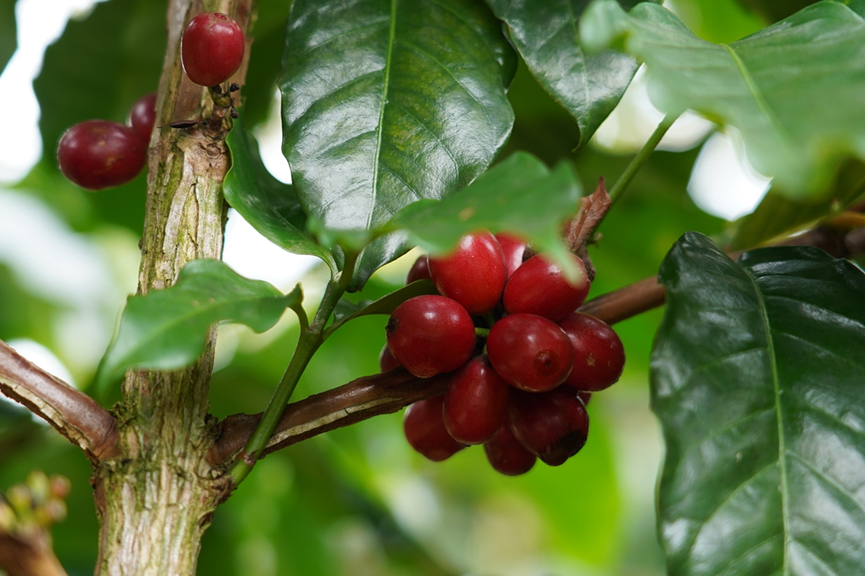
In terms of variety, Yunnan small-bean coffee initially featured Typica as the dominant variety. This is the oldest native variety from Ethiopia and the ancestor of many modern Arabica varieties. Typica has bronze-tipped leaves and bean shapes that are oval or slender, offering elegant flavor traits but relatively weak disease resistance and lower yields. Later, due to the demand for higher yields and disease resistance, many farms switched to planting Catimor. Catimor was developed in 1959 by Portugal through the hybridization of Timor and Caturra, featuring high resistance to leaf rust and abundant yields. However, due to its Robusta genetic component, its flavor often tends to be bolder with slight off-notes.
If you’d like to try pour over with Yunnan coffee, here are practical suggestions for two classic beans. Using a V60 filter, for example, its wide opening and unique spiral ribs help improve gas release efficiency during extraction. While this may sacrifice some body, it highlights the unique fruit acidity and aroma of Yunnan coffee. The recommended water temperature is 90–92°C, with a 1:15 coffee-to-water ratio and medium-fine grind (similar to fine sugar, EK43s #10.5 or about 75% passing rate through a Chinese standard No. 20 sieve). A specific technique can involve a staged extraction: start with a 30-second bloom using 30 grams of water, then pour in a small circular motion until reaching 124 grams for the first pour. After the water level drops, continue pouring up to 227 grams to finish, with a total extraction time of about 2 minutes.
For those who prefer natural-processed flavors, it is recommended to switch to a KONO filter, slightly lowering the water temperature to 86–88°C, while maintaining the same 1:15 coffee-to-water ratio and medium-fine grind. This method helps fully showcase the berry-like acidity and rich sweetness brought by the natural processing.
Here is a summary of the flavor profiles of three popular Yunnan coffee beans: 2013 Typica (produced in Baoshan, 1,200 meters elevation, washed process) features a rich yet non-bitter taste, with pronounced floral notes, a mid-palate hint of melon-like sweetness, and an aftertaste reminiscent of the smoothness of black tea; Yunnan Small Bean (produced in Baoshan, 1,200 meters elevation, washed process) showcases a nutty profile, accompanied by layers of herbal, chocolate, and caramel notes, with a gentle fruity acidity in the aftertaste; 2013 Natural Typica (produced in Lincang, 1,300 meters elevation) offers bright berry acidity, a nutty base, and a sweet aftertaste akin to brown sugar, with a tea-like finish, delivering an overall rich and varied flavor.
The above content is compiled by CoffeeHunters, a coffee news website.


