








Introduction:Civet coffee, commonly known as "cat poop coffee," originates from Sumatra, Indonesia, and is renowned for its rare production origin and unique intestinal fermentation process. This article delves into its historical background, flavor characteristics, suitable brewing methods, market pricing, and offers practical roasting and extraction advice to help you rationally assess whether this highly talked-about specialty coffee is worth trying.
Civet coffee, or the well-known "cat poop coffee," is an extremely rare coffee variety from the Indonesian archipelago of Sumatra. Though its name is dramatic, it stems from a unique "internal fermentation" process—where civets consume ripe coffee cherries, and through the action of digestive enzymes and gut bacteria, the beans are excreted in their feces. These beans are then collected, cleaned, roasted, and become a highly sought-after specialty coffee on the market.
This coffee is famous not only for its scarce production but also for its distinctive fermentation process, which results in a flavor profile vastly different from typical Indonesian coffees. Generally, civet coffee has a richer, fuller body with complex layers, and some batches even exhibit unique notes of earthiness, herbs, and syrup, beloved by certain coffee enthusiasts. However, it is also widely debated due to its high price and ethical concerns.
Regarding the origins of civet coffee, there’s a long-circulated anecdote. It’s said that during the Dutch colonization of Indonesia in the 17th century, local farmers were troubled by weasels stealing coffee cherries, only to unexpectedly find undigested coffee beans in the animals’ feces. A Dutch officer named Willemsen, after tasting coffee brewed by farmers using these “special beans,” was amazed by its smooth and rich flavor, thus beginning the legendary tale of “cat poop coffee.”
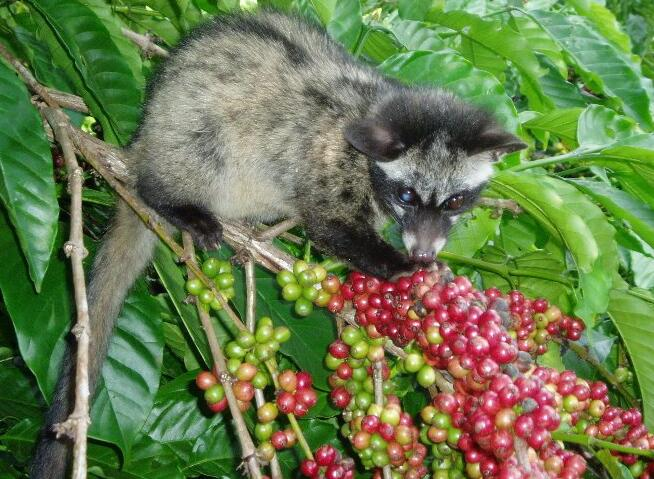
Traditionally, civets primarily consume coffee cherries of the Robusta variety grown at low altitudes, so most civet coffee is actually of the Robusta species. This type of coffee usually has distinct earthy, herbal notes and high viscosity, with some consumers comparing its profile to aged Indonesian beans or Indian monsooned beans. Those who favor such flavors may particularly appreciate it. However, there are also a few instances where Arabica varieties grown at higher altitudes are consumed by civets, resulting in relatively more delicate flavors, though production remains extremely limited.
The so-called "internal fermentation method" refers to the process where, after consuming coffee cherries, the lactic acid bacteria and digestive enzymes in the civet’s gut break down the fruit pulp and mucilage, giving the coffee beans a unique fermentation treatment as they pass through the intestines. Eventually, these “naturally processed” beans are excreted in the civet’s feces, collected, cleaned, and sorted by local farmers in the early morning, then subjected to subsequent roasting procedures. Since civets naturally select ripe, higher-quality coffee cherries, this “animal selection” mechanism theoretically ensures a baseline quality of the beans.
It’s worth mentioning that besides Indonesian civet coffee, there are other similar “animal-processed” coffees around the world, such as the Jacu bird coffee from South America, monkey coffee from India, and elephant dung coffee from Sri Lanka. While each of these coffees has its own unique traits, they are generally rare, expensive, and also raise concerns about animal ethics.
For brewing civet coffee, it is recommended to use a medium-dark roast to fully bring out its herbal, nutty, and slightly earthy complex flavors. In practice, using a KONO filter for pour over is a common and recommended method, as its straight ribs reduce excessive degassing and prolong the contact time between water and coffee grounds, helping enhance body and extraction efficiency.
Recommended brewing parameters are as follows: water temperature controlled at 86–87°C, grind size similar to white sugar, and a coffee-to-water ratio of 1:15 (e.g., 15 grams of coffee grounds to 225 milliliters of water). The specific brewing steps are as follows: start with a 30-gram bloom for 25 seconds; then pour 125 grams of water, and when the water level drops halfway, pour the final 225 grams until extraction is complete, with a total brew time ideally between 1 minute 50 seconds and 2 minutes. Maintain a steady flow rate during brewing and avoid over-stirring to prevent over-extraction.
Regarding roasting recommendations, a medium-dark roast generally highlights the herbal and nutty tones of civet coffee better. Taking the Yangjia 800N roaster as an example, it is advised to preheat the drum to 200°C, with a bean inlet temperature of about 160°C, damper opening at 3, and heat at 130. After reaching the turning point, gradually adjust the heat and damper, closely monitoring the timing of first crack and the development phase. The beans should be dropped at around 203°C.
Although civet coffee possesses unique flavor charm, its production process is controversial. Most commercially available civet coffee today comes from civets kept in cages and force-fed coffee cherries of varying ripeness, which not only affects coffee quality but also raises serious animal welfare issues. As a result, many producers and consumers are beginning to reconsider whether it’s worth supporting a product with potential ethical flaws for the sake of such a “gimmick.”
If you’re particularly fond of the bold body of Indonesian coffee but wish to avoid animal welfare controversies, consider other high-quality alternatives—such as this coffee bean, which has undergone multiple hand-sortings and has an extremely low defect rate. It showcases the solid texture and rich aroma typical of Indonesian coffee, making it equally suitable for coffee lovers who enjoy strong flavors and lingering aftertastes.
The above content is compiled by CoffeeHunters, a coffee news website.


