







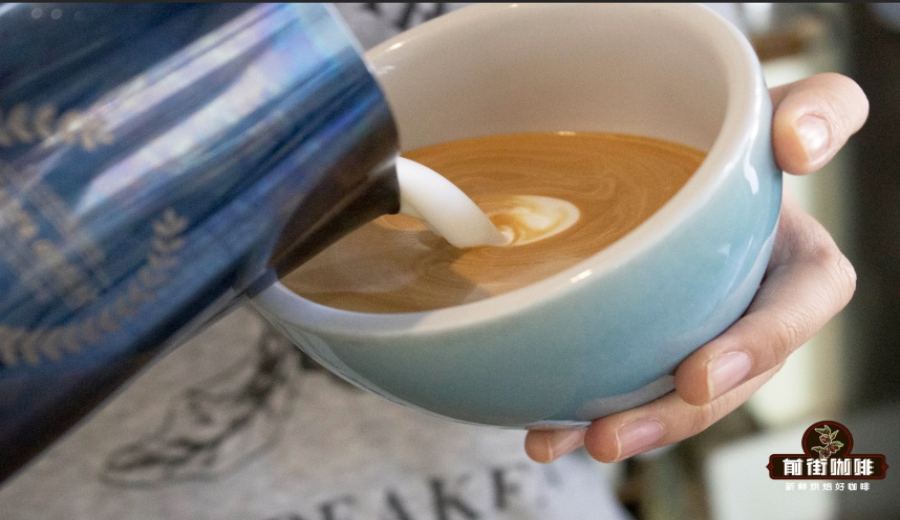
Introduction:Many coffee enthusiasts often encounter issues such as misaligned patterns or off-center designs when practicing latte art. In addition to lack of technical proficiency, this is actually closely related to the condition of the milk foam, the timing of cup return, and the choice of initial pouring point. This article delves into the three main reasons why latte art patterns are not centered — including overly thin milk foam, returning the cup too quickly, and choosing an incorrect starting point — and provides specific adjustment suggestions to help you accurately master latte art positioning and enhance overall visual presentation.
In the world of coffee latte art, in addition to delicate lines and smooth motion, the overall composition of the pattern also plays a key role. Among these, centered composition is the most classic and common presentation method, especially suitable for most symmetrical patterns, creating a stable and balanced visual effect. However, many beginners often face a frustrating issue: the latte art pattern consistently deviates from the center of the cup. In fact, this is often related to three common mistakes: improper milk foam thickness, returning the cup too quickly, and choosing an incorrect starting point. Mastering these details will greatly improve your success rate in latte art.

The beauty of composition lies not only in the fluidity of the lines and the design of the pattern, but also in the arrangement of the pattern’s position within the cup. Good composition can guide the viewer’s gaze and make the entire cup of coffee look more professional and pleasing to the eye. Centered composition is widely favored because it enhances the balance of symmetrical patterns, especially suitable for common shapes like hearts and leaves. But in practice, many novices often find that their poured patterns lean to the left or right, or even appear unbalanced vertically. To improve this situation, we first need to understand the three common technical issues behind it.
First,the thickness of the milk foam greatly affects the stability and control of latte art.Many people overlook the importance of milk foam texture during the initial stages of practice. Ideally, the milk foam should have a moderate thickness. Overly thin milk foam, while appearing delicate, has too much fluidity and is easily affected by slight forces during the pouring process, causing the pattern to shift. When the milk foam is too thin, even a little extra force or slightly increased flow can push the pattern away from the center, resulting in uneven textures or jagged edges. If you find that the lines of your poured pattern are blurry or the edges are unclear, it is likely due to overly thin milk foam. The solution is simple: extend the steaming time to create milk foam that is denser and has appropriate viscosity, which can significantly improve control.

Second,the rhythm and control of the cup-returning action are also key factors influencing pattern placement.Returning the cup refers to the action of gradually bringing the tilted cup back to an upright position as the pattern forms during pouring. This step needs to be coordinated with the arm movements used in pouring, which is often a major challenge for beginners. If the cup is returned too quickly, the rapid return to upright changes the flow direction of the liquid, increasing the impact force of the milk foam injection and pushing the already-formed pattern away from the center. This situation is common among beginners who have not yet mastered the synchronization of cup angle and hand movement. It is recommended to practice repeatedly to gradually develop an intuition for changes in cup angle and to find a cup-returning rhythm that suits you.
The third common mistake ischoosing an inappropriate starting point for the initial pour.Different latte art patterns actually have different optimal starting positions. For example, a classic heart-shaped pour often suggests starting from a point slightly above the center of the cup, which helps the lines naturally extend downward; whereas a leaf pattern usually begins slightly below the center, allowing the leaf veins to flow out smoothly. If the starting point is not correctly determined at the beginning of the pour, even if the subsequent movements are smooth, the overall pattern may still deviate from the center, affecting visual balance. Therefore, before starting to pour, it is advisable to observe the pattern design and confirm the center point of the cup, then choose the most suitable starting position based on the characteristics of the pattern.

In addition, to pour beautiful and symmetrical patterns, a consistently well-extracted shot of espresso is an indispensable foundation.The richness and texture of the espresso’s crema directly affect the outcome of the latte art.Ideally, the espresso should have a fine, golden, and long-lasting crema, which not only improves the adhesion of the latte art but also makes the patterns more three-dimensional and vivid. When selecting coffee beans, it is recommended to choose blends with medium body, balanced acidity and bitterness, and good crema performance, which helps create better conditions for latte art.

In summary, the issue of latte art patterns not being centered is not caused by a single factor, but rather results from the combined influence of milk foam texture, cup-returning control, and starting point selection. By addressing these three common problems and practicing consistently to familiarize yourself with hand feel and rhythm, even beginners can gradually pour symmetrical and aesthetically pleasing patterns. Remember, latte art is not just about technique, but also a challenge of detail and patience. Mastering these key points will take your coffee artistry to the next level.
The above content is compiled by CoffeeHunters, a coffee news website.


