







Introduction:Indonesian Mandheling coffee is renowned for its rich and bold flavor, but what sets PWN Golden Mandheling apart from the commonly seen G1 grade? This article delves into Indonesia’s green coffee grading system, explaining the differences between G1 and G6 grades based on key indicators such as defect rate and bean size, and reveals how PWN achieves its high-quality Golden Mandheling through multiple layers of screening. It also provides professional pour over brewing recommendations to help coffee enthusiasts fully experience the classic flavors of this Sumatran bean.
Indonesian Mandheling coffee has long been favored by coffee lovers worldwide for its full-bodied and robust taste. However, many may not be familiar with Indonesia’s coffee bean grading standards. In particular, what are the specific differences between PWN’s Golden Mandheling and the commonly available G1-grade Mandheling on the market? This article will take you through a comprehensive understanding of Indonesia’s green coffee grading system, analyzing the G1 to G6 grade criteria in detail from key dimensions such as defect rate and bean size, and exploring how PWN creates its uniquely premium Golden Mandheling through a rigorous selection process.
The grading of Indonesian green coffee beans is primarily based on the number of defective beans, while also taking into account bean size. Indonesia’s standard quality requirements include: no live insects, no moldy or foul-smelling beans, a maximum moisture content of 12.5%, and an impurity rate below 0.5%. Based on the number of defective beans in a 300-gram sample, coffee beans are classified into six grades, from G1 to G6. Among them, the G1 grade requires fewer than 11 defective beans in a 300-gram sample, making it the highest grade of Indonesian green beans.
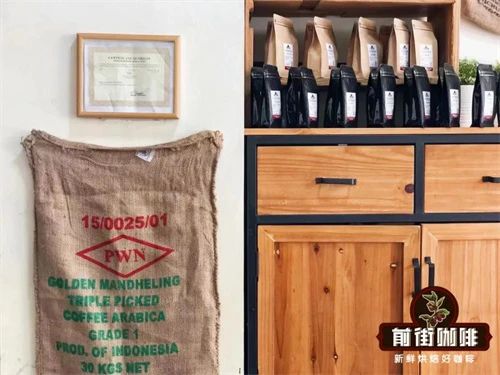
Generally, the packaging of Indonesian green coffee beans will indicate the country of origin, grade, and supplier information. For example, certain coffee brands offer both Indonesian Lintong Mandheling and PWN Golden Mandheling, both of which are classified as G1. However, PWN Golden Mandheling undergoes further strict screening, using only beans that are size 18 or larger—that is, top-tier G1 beans with fewer than 3 defective beans in a 300-gram sample. These beans are handpicked and machine-sorted more than three times to ensure each bean is uniformly shaped, large in size, and has a bright, clear color.
PWN, short for Pwani Coffee Company in Indonesia, is the exclusive brand owner of Golden Mandheling. The company has registered “Golden Mandheling” as a trademark, meaning that only Golden Mandheling produced by PWN can be considered authentic. To identify genuine PWN Golden Mandheling, check for the PWN logo on the packaging or verify the origin certificate signed by PWN. These authentic beans typically feature intense flavors of dark chocolate, caramel, and nuts, along with unique herbal and spicy notes.
The selection process for Golden Mandheling is extremely rigorous. PWN not only uses high-quality G1-grade green beans but also performs multiple rounds of machine and manual sorting to ensure each bean meets high standards. In addition, PWN conducts density and color sorting of the green beans to further enhance uniformity and color consistency. These stringent selection steps result in a PWN Golden Mandheling that offers a cleaner, brighter cup, with more pronounced body and sweetness.
For coffee enthusiasts looking to brew PWN Golden Mandheling, a pour over method is recommended to fully experience its rich regional characteristics. When using medium-dark roasted PWN Golden Mandheling, it is advised to set the water temperature at 87°C and use a medium grind size (70% passing rate through a Chinese standard No. 20 sieve). Use a KONO filter cone and employ a three-stage pouring technique: start with a 30-gram bloom for 30 seconds, then slowly pour in a circular motion from the center up to 125 grams, wait for the water level to drop, and continue pouring up to 225 grams, with a total extraction time of about 2 minutes.
These brewing parameters effectively prevent over-extraction, reducing the occurrence of burnt or astringent flavors, and allow the coffee’s aroma and flavor to shine through optimally. Once brewed, you’ll be greeted with a strong aroma of dark chocolate, accompanied by harmonious notes of roasted hazelnuts, caramel, and melon, with distinct spicy undertones on the palate and a long-lasting aftertaste.
The above content is compiled by CoffeeHunters, a coffee news website.


