







Introduction:Indonesian coffee is often named after its producing region, yet the renowned beans from Sumatra are uniquely called "Mandheling." Behind this name lies a wartime misunderstanding. This wet-hulled processed coffee is famed for its rich herbal and spicy profile, making it ideal for those who enjoy bold flavors. This article explores the origin of the Mandheling name, its flavor characteristics, and recommends two Indonesian Mandheling products suitable for beginners and advanced enthusiasts alike, teaching you how to choose fresh, defect-free specialty beans.
Many coffee lovers may notice that Indonesian coffees are typically named after the islands they come from, such as Java, Sulawesi, or Sumatra. However, one standout coffee defies this convention—the "Mandheling" from Sumatra. This name doesn’t derive from the region or variety but stems from a historical mix-up, and its unique flavor is inseparable from the local wet-hulling process. This article will take you deep into the origins of the Mandheling name, the reasons behind its distinctive flavors, and recommend two Indonesian Mandheling products to help you find your perfect specialty bean.
When tasting coffee, many may observe that Indonesian beans are often named directly after their islands—like Java, Sulawesi, or Sumatra. Yet one famous exception breaks this rule: Mandheling coffee from Sumatra. So why is Sumatran coffee called Mandheling?
In fact, the name "Mandheling" doesn’t come from the region or variety but originates from a WWII-era misunderstanding. At the time, a Japanese soldier in a café in northwestern Sumatra, Indonesia, sipped a richly flavored coffee and asked the shop owner what kind it was. Due to a language barrier, the owner misunderstood the question as asking about his ethnicity and replied: "mandheling (Mandailing people)." After the war, the soldier returned to Japan, forever remembering that coffee referred to as "Mandheling." By 1968, Japanese merchants visited the N.V. Pawani Medan company in Indonesia to purchase 15,000 kilograms of Sumatran Mandheling coffee, which became hugely popular in the Japanese market. Since then, Mandheling has become synonymous with Sumatran Arabica beans.
So, what flavor characteristics does Mandheling coffee have? Generally, Mandheling coffee is roasted to a darker level, which reduces acidity and yields a richer, more full-bodied taste with smoky notes, along with earthy, spicy, and woody aromas. This unique flavor profile is largely thanks to the region’s distinctive "wet-hulling" processing method.
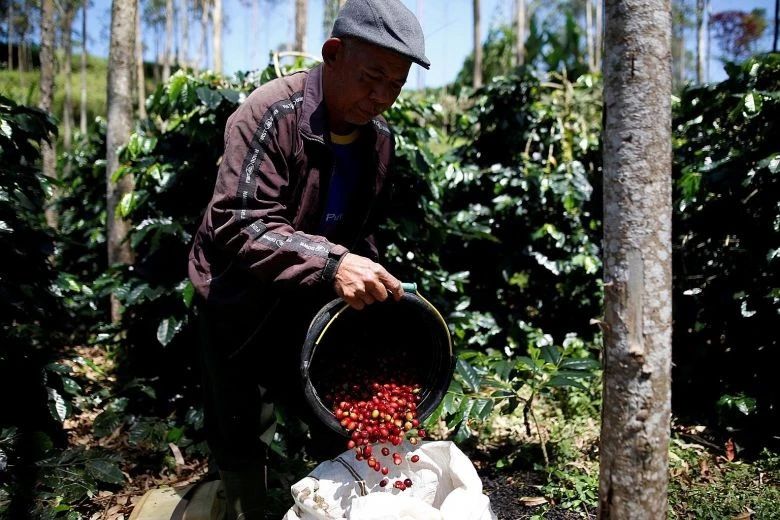
Sumatra has a typical tropical rainforest climate, with high rainfall and humidity year-round, frequent typhoons, and limited freshwater resources, making traditional washed processing or long sun-drying methods impractical. As a result, local farmers developed the wet-hulling method, which completes processing in just four days, drastically shortening fermentation and drying times. This not only improves efficiency but also creates the signature herbal, spicy, and woody tones of Mandheling. This flavor is also one of the classic characteristics of Southeast Asian coffee.
If you want to get a first taste of Mandheling’s regional character, we recommend starting with entry-level Indonesian Mandheling G1 beans. Sourced from theLintong region of Sumatra, these beans are graded as G1—the highest grade among Indonesian green beans—and are processed using wet-hulling and dark roasting. They perfectly showcase the classic caramel, spice, nut, and dark chocolate aromas of Mandheling. With a rich, bold flavor and low acidity, they’re great for brewing via pour over, moka pot, or clever dripper, and are also ideal for beginners as practice beans. These beans are shipped within 24 hours of ordering and are all freshly roasted within 5 days to ensure peak flavor.
The Lintong region is located in the mountainous areas around Lake Toba in northern Sumatra. This lake is a high-altitude freshwater body situated north of Medan, the provincial capital of Sumatra, at an average elevation of about 900 meters. Lintong Mandheling, processed with the wet-hulling method, features intense herbal and earthy aromas, making it a classic representative of Asian coffee flavors and a favorite among many serious coffee enthusiasts.
If you’re looking to try a higher-quality Mandheling, we recommend PWN Golden Mandheling. PWN is short for "N.V. Pawani Medan company," a trading firm specializing in selecting and exporting premium-grade Mandheling green beans. Their "Golden Mandheling" is considered the flagship of specialty Mandheling. Early Japanese importers noticed the inconsistent quality of local beans, so they established strict defect sorting standards—including assessments of bean density, size, shape, and color—and implemented one machine sort and four rounds of manual hand-picking to ensure each bean is whole, large, and translucent, significantly reducing earthy and grassy notes. Legend has it that under sunlight, these beans exhibit a golden sheen, hence the name "Golden Mandheling."
Freshly roasted PWN Golden Mandheling offers cedarwood, nut, spice, and herbal aromas in the dry scent, while hot water brings out sweet notes of licorice and caramel. On the palate, it delivers layers of black chocolate, cocoa, nuts, and spices, with a clean profile, pronounced aftertaste, and high body. These beans are suitable not only for pour over, French press, or siphon brewing but also work excellently as drip bags, showcasing the essence of Golden Mandheling just as well.
The above content is compiled by CoffeeHunters, a coffee news website.


