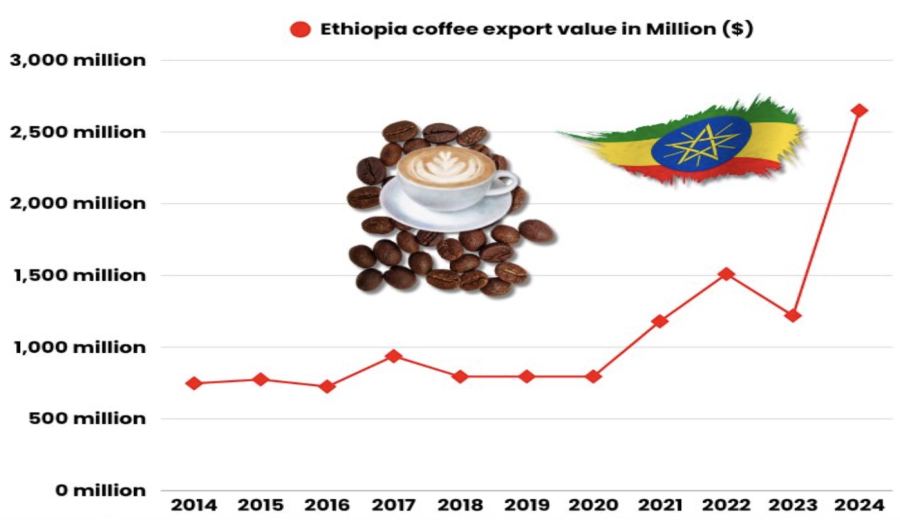
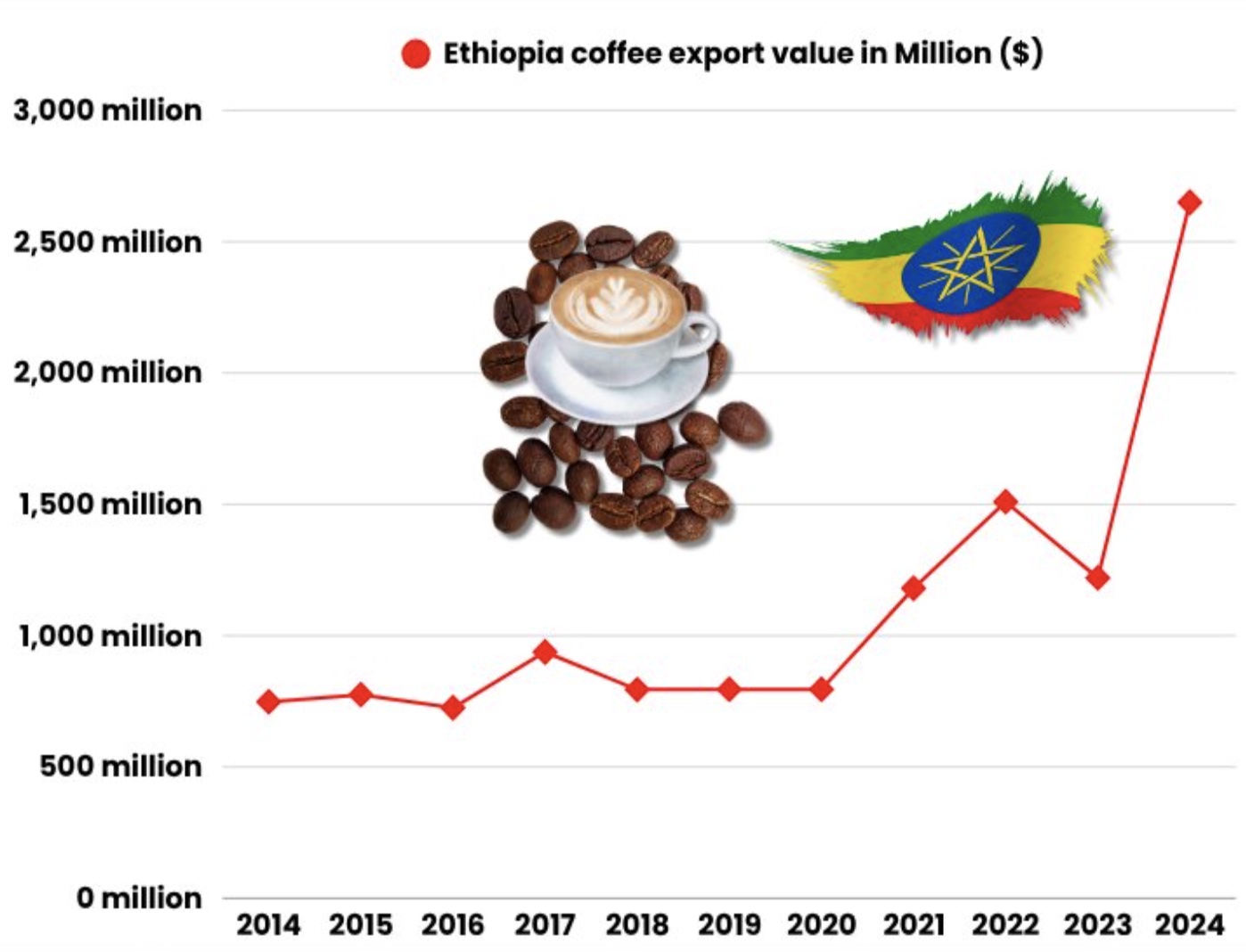
Introduction:As the birthplace of Arabica coffee, Ethiopia achieved another record-breaking performance in coffee exports for the 2024–2025 season, with total export value surpassing US$2.65 billion—its highest ever. This article provides an in-depth analysis of the latest Ethiopian coffee export data, major buyer countries, characteristics of popular growing regions, and future market trends to help you grasp key dynamics in the global specialty coffee supply chain.
Ethiopia is not only the birthplace of Arabica coffee but also a key supplier in the global specialty coffee market. In the 2024–2025 season, the country’s total coffee export revenue reached US$2.65 billion, up 9% from the previous year, with exports exceeding 7 million bags—solidifying its position as the world’s ninth-largest coffee exporter. This achievement reflects not only the resilience of its agricultural economy but also the competitiveness of Ethiopian coffee on the global stage.
Export Performance Hits New Heights: Key Insights Behind the Data
According to official export statistics, Ethiopia exported a total of 468,967 metric tons of coffee during the 2024–2025 fiscal year, equivalent to approximately 78,161 bags (calculated at 60 kg per bag), marking a historic high. Total export revenue reached US$2.65 billion, a significant increase of over US$1.2 billion compared to the US$1.43 billion in 2023–2024, with export volume rising by nearly 170,000 tons. This performance not only reinforces Ethiopia’s status as a leading global coffee supplier but also demonstrates its strong presence in the high-end Arabica market.
Who’s Buying Ethiopian Coffee? Analysis of Major Export Markets
Renowned for its unique flavors and high quality, Ethiopian coffee is widely favored across global markets. The main export destinations include Saudi Arabia, the United States, South Korea, Germany, Japan, China, Belgium, the United Arab Emirates, Sudan, and Italy. Among these,Saudi Arabia ranked first with US$238.98 million (accounting for 19.5% of total exports), followed closely by the United States and South Korea with US$144.21 million (11.8%) and US$111.73 million (9.1%), respectively. Germany and Japan also held substantial shares of 9.1% and 7.3%, highlighting steady demand for Ethiopian coffee across both European and Asian markets.
China has seen rapid growth in recent years, importing US$72.71 million (5.9%) worth of coffee in 2024–2025, reflecting huge consumption potential. Meanwhile, markets like Belgium and the UAE have become important partners due to their preference for specialty and high-quality coffee.
Ethiopian Coffee Growing Regions and Flavor Profiles
The diverse flavors of Ethiopian coffee stem from its many unique growing regions. Among them,Yirgacheffe is renowned for its floral, citrus, and tea-like notesand is a representative of washed specialty coffee;Sidamo features both fruity and wine-like aromasand offers both washed and natural processing methods;Harrar is known for its intense wild fruit and berry characteristics, mostly processed using the natural method;Guji has gained significant attention in recent years, often showcasing tropical fruit and floral notes, making it well-suited for the specialty market. In addition, regions such as Limu and Jimma attract coffee enthusiasts with their balanced chocolate and spice profiles.
Coffee Processing and Cultivation Overview
Ethiopian coffee production primarily relies on smallholder farmers, with each farm typically covering less than two hectares. Approximately 70–80% of coffee is processed using the natural (sun-dried) method, while the remaining 20–30% is washed (wet-processed). Nearly 100% of Ethiopia’s coffee production is Arabica, cultivated at altitudes ranging from 1,500 to 2,200 meters. The unique altitude and fertile volcanic soil give rise to its irreplaceable flavor characteristics.
Future Trends and Challenges
Looking ahead to 2025–2026, Ethiopia’s coffee production is projected to reach 11.6 million bags (approximately 696,000 tons), with exports expected to hit 7.8 million bags. As global demand for Arabica coffee rises—especially amid supply instability in Brazil—Ethiopia’s market position will become even more pivotal. At the same time, the growth in specialty coffee demand, policy reforms, and infrastructure investment are providing further momentum for exports.
However, the country also faces multiple challenges, including the impact of climate change on yields, limited resources for smallholders, an export focus predominantly on green beans, and the cost pressures of meeting international sustainability and certification standards. Value-added transformation, market diversification, and climate adaptation strategies will be key to future development.
Conclusion: Ethiopia’s Global Role in Coffee
The 2024–2025 season marks a significant milestone for Ethiopia’s coffee industry, with exports nearing 469,000 tons and revenues hitting a new high of US$2.65 billion. From smallholder farmers to top-tier exporters, Ethiopia continues to play an irreplaceable role in the global specialty coffee market, thanks to its regional diversity and genetic variety advantages. Moving forward, as market demands evolve and the industry upgrades, Ethiopia is poised to further solidify its position as one of the world’s premier suppliers of Arabica coffee.
The above content is compiled by CoffeeHunters, a coffee news website.