Introduction:Harar is one of Ethiopia’s oldest coffee-growing regions and the birthplace of coffee commercialization in the world. This article delves into Harar’s geography, unique varieties, traditional sun-drying processing methods, and its distinctly “Old World” cup profile. From regional characteristics to its journey toward specialty production, and practical pour over parameters, we’ll take you on a comprehensive journey to discover this classic coffee with its wine-like and spicy flavor notes.
Harar (Harar) is located on the eastern plateau of Ethiopia and is one of the highest-altitude coffee-growing regions in the world, ranging approximately between 1500 and 2200 meters above sea level. It is not only one of Africa’s oldest coffee cultivation areas but also an important origin of commercialized coffee. Legend has it that as early as the 6th century, shepherd Kaldi discovered coffee in the Kaffa forests, but it was Harar that truly propelled coffee into large-scale cultivation and trade. As early as the 15th century, Harar’s coffee was exported to the Middle East and Europe via the port of Mocha, predating even Yemeni Mocha coffee.
The geographical conditions of Harar have a profound impact on coffee cultivation. Situated on the eastern side of the East African Rift Valley, it features a typical highland climate with annual rainfall of only 700 to 900 millimeters, making it one of the driest coffee-growing regions in Africa. Compared to other Ethiopian regions, Harar’s climate is drier, which forces coffee tree roots to grow deeper into the soil, resulting in beans with intense and layered flavors. The region’s soils are diverse, including volcanic types such as basalt and sandstone, providing the coffee with unique mineral nutrients.
Harar primarily cultivates native Ethiopian Heirloom varieties, commonly referred to locally as "Dega" and "Wolisho." These varieties differ from those found in the Sidamo region. Having long adapted to arid environments, they have evolved deeper root systems, tougher leaves, and stronger drought resistance. These traits are also reflected in the coffee’s flavor, yielding a more stable and distinctive taste profile.
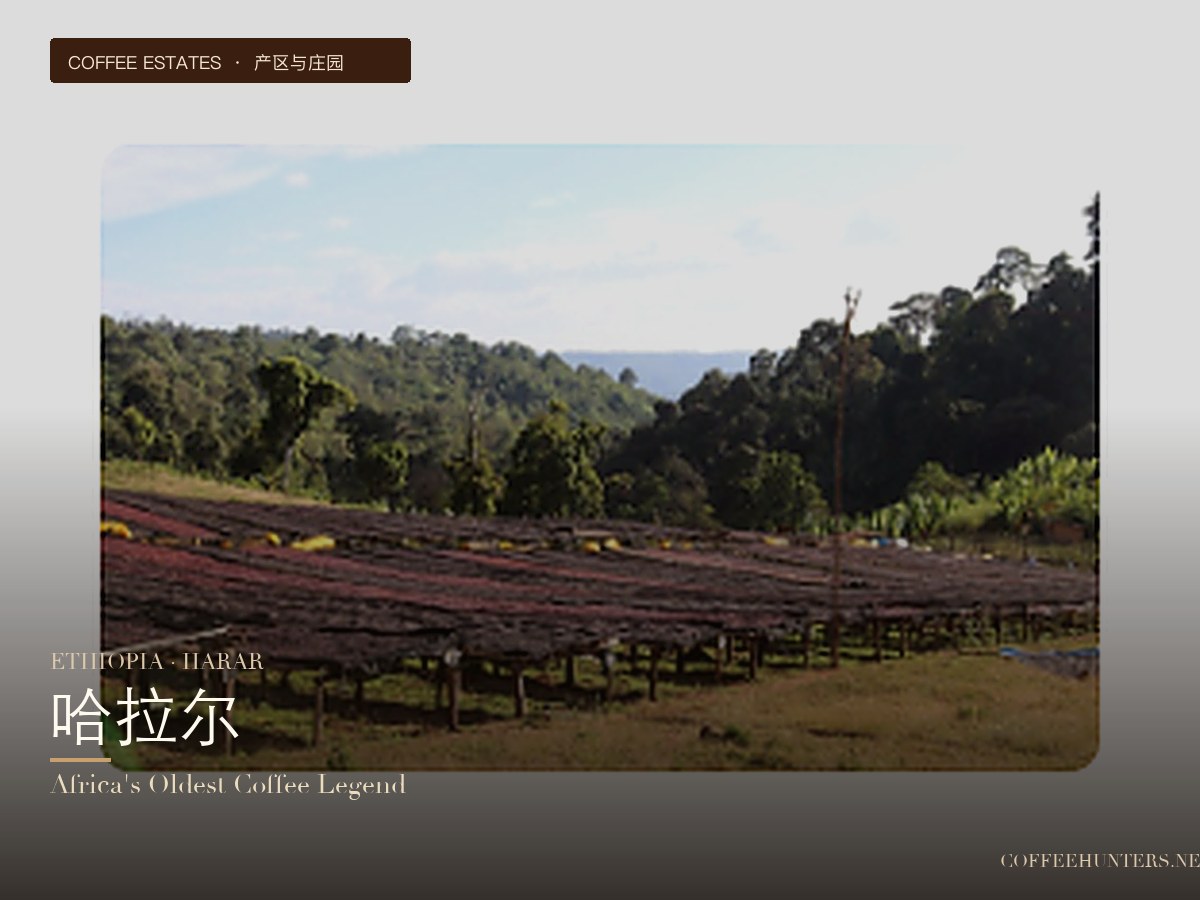
What Harar is most famous for is its unique coffee processing method — the “Harar Sun-Dried” method. Unlike common sun-dried processes, Harar’s coffee cherries are left to overripen naturally on the branch for about three to four weeks before being manually harvested. The harvested cherries are then placed on wooden racks and slowly sun-dried for 15 to 21 days, during which they are regularly hand-turned to ensure even drying. Some green beans are further stored in burlap sacks for several months after drying, allowing residual sugars from the fruit pulp to continue penetrating the bean core, thereby further deepening the flavor. This elaborate process gives Harar coffee its distinctive “winey” and “fermented” character.
Cupping Harar sun-dried coffee is a deep sensory journey. The aroma bursts forth with complex notes of blueberries, wine, and fermented fruits. On the palate, acidity is low to medium, with a full and rich mouthfeel. The mid-palate reveals layers of dark chocolate, earth, spices, and dried fruits, while the finish carries distinct notes of red wine, tobacco, and herbs. The overall flavor is complex and layered, showcasing the rich “Old World” coffee qualities.
There is a deep historical connection between Harar and Yemeni Mocha. Between the 16th and 17th centuries, Harar coffee was extensively exported to Europe via the port of Mocha, which is why the term “Mocha” today sometimes refers to both Yemeni and Harar coffee. The two regions also share flavor similarities, such as fermentation notes, spice tones, and earthy characteristics, often leading to comparisons in the international market.
The Harar region includes several important sub-regions, such as the area around the city of Harar, Dire Dawa, Chiro, and Gelemso. Among these, the area surrounding Harar city is the most representative core zone, where coffee is mostly grown in mountain terraces at altitudes of 1800 to 2200 meters. The microclimate and soil conditions contribute to the unique personality of the coffee from this area.
In the past, Harar’s coffee industry was largely driven by smallholder farmers, and the pace of specialty development was relatively slow. However, in the past five years, processing stations such as Aricha and Idido have started to offer selected lots, gradually improving quality. Since 2017, the Ethiopia Commodity Exchange (ECX) has allowed farmers to directly export specialty lots, enabling Harar’s high-quality coffees to enter the international specialty market more directly.
Notable estates in Harar include Harar Highlands Estate, Chiro Estate, and Aricha Estate. It’s worth noting that although Aricha is primarily a processing station in the Sidamo region, some of its coffee lots also come from the Harar region, demonstrating the potential for cross-regional collaboration.
Brewing Harar sun-dried coffee requires special attention to its fermented characteristics and low acidity. It is recommended to use a V60 or Origami dripper, with water temperature controlled at 88 to 90°C (slightly lower than the standard), and a brew ratio suggested between 1:16 and 1:18, using a medium-fine grind size. During brewing, a single-pour method is advised: after a 30-second bloom, pour water with a thin stream for about 60 seconds to avoid over-extraction and unwanted off-flavors, thereby fully highlighting its unique aromas and layered complexity.
In summary, Harar is not only one of Ethiopia’s oldest coffee-growing regions, but also a key cornerstone of global coffee history. To understand Harar is to trace the origins of coffee’s journey from tradition to the world. From its unique geography and traditional processing methods to its richly layered cup profile, Harar coffee carries the roots and soul of coffee culture.
The above content is compiled by CoffeeHunters, a coffee news website.