Introduction:Dive deep into how Panama’s Boquete region nurtures some of the world’s finest Geisha coffee. From its geography, varietal origins, to renowned farms and auction history—this article offers a comprehensive guide to this uniquely flavorful specialty coffee bean. It also includes practical pour over parameters and flavor identification tips, perfect for coffee lovers looking to taste or collect Geisha.
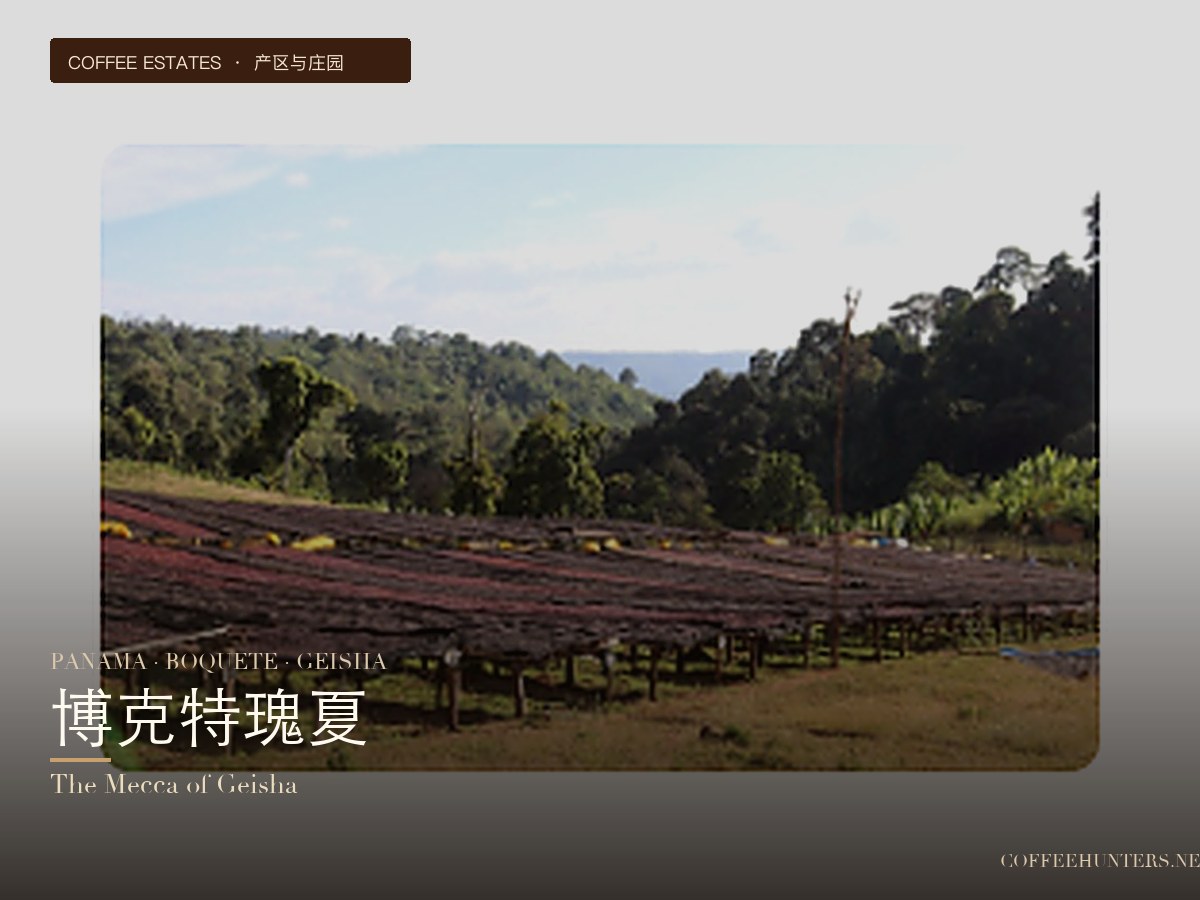
Nestled within Chiriquí Province in western Panama lies a mountainous region hailed as a sacred ground for specialty coffee—Boquete. Situated at the foothills of Volcán Barú, it sits between elevations of 1,200 to 2,000 meters above sea level, with an average annual temperature of about 16 to 22°C and over 2,000 mm of rainfall per year. Blessed with volcanic soils, frequent mountain mists, and dual airflow from both the Pacific and Atlantic Oceans, Boquete has become one of Central America’s most iconic high-altitude specialty coffee regions—and a must-visit pilgrimage site for those seeking top-tier Geisha beans.
To talk about Geisha (also commonly translated as Artisia), we must go back to 1936. Originally from the Gesha Mountains in southwestern Ethiopia, seeds of this coffee variety were brought to Kenya’s Scott Laboratory, then transferred to CATIE Agricultural Research Center in Costa Rica in 1953, and only introduced to Panama in the 1960s. However, Geisha truly rose to fame in 2004 when Daniel Peterson of Hacienda La Esmeralda discovered, quite by chance, that coffee beans from a particular tree in his grandfather’s plantation produced cupping results of unparalleled excellence. This coffee later entered the Best of Panama competition and was sold at an astonishing $21 per pound—the equivalent of more than ten times the global average coffee auction price at the time—ushering in the legendary era of Geisha.
Hacienda La Esmeralda now lies on the high slopes of Boquete at elevations between 1,500 and 1,800 meters, and is divided into several well-known micro-regions such as Jaramillo, El Velo, and Palma. The estate categorizes its Geisha production into three major series: Red Label (Grand Reserve), Green Label (Reserve), and Blue Label (Private Collection). Among them, the Red Label represents the top lots that win awards at the Best of Panama competition each year. Its quality is unmatched, having even set a world record of over $10,000 per pound—truly a legend in the coffee world.
What makes Geisha stand out in the global coffee market is its stunning cup profile. When brewed, Geisha often exudes intense floral and fruity aromas such as jasmine, orange blossom, and bergamot. Its acidity is bright and refreshing, often featuring notes of lemon, lime, and grapefruit. The sweetness takes on a smooth texture reminiscent of honey and peach, while the aftertaste lingers delicately like fine tea. With a clean overall flavor profile, distinct layers, and a long finish, it has been hailed as the “Champagne of coffee,” a unique character rarely found among other mainstream Central American varieties.
Beyond Hacienda La Esmeralda, Boquete is home to many other exceptional specialty coffee farms, such as Hacienda La Esmeralda (essentially the same management team as Hacienda La Esmeralda but under a different brand name), Finca Lerida, Finca Deborah, and Finca Auromar. Among these, Finca Deborah is particularly renowned for its anaerobically fermented Geisha. Each limited batch offers highly distinctive flavors, making it a much-sought-after item among coffee professionals and collectors.
The Best of Panama (abbreviated as BOP) is the most prestigious competition and auction event in the global specialty coffee industry, hosted annually by the Specialty Coffee Association of Panama (SCA Panama). BOP not only serves as a stage to evaluate specialty coffees from various farms, but its Geisha auction segment is considered a “pilgrimage” for owners of specialty coffee shops, roasters, and buyers around the world. For example, in 2023, the washed Geisha champion of that year’s BOP sold for an astounding $10,500 per pound, once again breaking the world record and highlighting Geisha’s lofty status in the specialty coffee market.
If we examine the flavor profile of Boquete Geisha in detail, it can be summarized as a combination of “floral and fruity notes + tea-like sensation + tartaric acid”: including elegant aromas such as jasmine, orange blossom, and bergamot, paired with the vibrant acidity of lemon and lime, along with the sweet flavors of honey and peach, plus a tea-like aftertaste reminiscent of sipping fine tea. In contrast, other common varieties in the Boquete region, such as Catuai or Caturra, exhibit a more typical Central American washed style, characterized mainly by chocolate, citrus, and caramel notes—offering a distinctly different flavor profile.
For coffee enthusiasts who enjoy pour over brewing, preparing Geisha requires extra care and skill. It’s recommended to use high-flow filter cones such as V60 or Origami, with water temperature controlled between 88 to 90°C (slightly lower than general coffee brewing recommendations). The coffee-to-water ratio should be between 1:16 and 1:18, and the grind size should be medium-fine to fine (slightly finer than usual for pour over). In practice, you can use the single-pour (blooming followed by continuous pouring) method: start with a 30-second bloom, then slowly pour water for about 60 seconds to complete extraction. Be aware that too high a water temperature, too coarse a grind, or improper brewing time can easily lead to under-extraction, resulting in a flat cup, or over-extraction, causing unpleasant astringency.
In summary, Geisha has not only redefined the value of specialty coffee but has also elevated coffee from a traditional agricultural product to the realm of luxury and collectibles. Its emergence has made Panama’s Boquete the “Mecca” for coffee lovers and professionals worldwide, and has led us to rethink the sensory experience and cultural significance that a cup of coffee can offer. Understanding Geisha is not just about tasting a coffee—it’s about unlocking a key to the transformations in the 21st-century specialty coffee industry.
The above content is compiled by CoffeeHunters, a coffee news website.