








Introduction:From the late 19th century when French missionaries planted the first coffee tree in Zhukula, Yunnan, to Yunnan becoming China’s largest coffee-producing region today, this over-century-long development journey is filled with many fascinating stories. This article delves into the three main coffee varieties in Yunnan—Typica, Bourbon, and Catimor—exploring their historical origins, botanical characteristics, growing environments, and flavor profiles. Through actual cupping data, it analyzes the differences in brewing and tasting among these varieties, helping coffee enthusiasts gain a more comprehensive understanding of the true face of Yunnan specialty coffee.
As the core coffee-growing region in China, Yunnan’s coffee cultivation history dates back over a hundred years. As early as 1904, a French missionary planted the first batch of coffee trees in Zhukula Village, Binchuan County, Yunnan. This also marks the earliest recorded coffee cultivation in mainland China. Over time, classic Arabica varieties such as Typica and Bourbon were gradually introduced and took root in the region. This long planting history not only witnessed the evolution of varieties but also reflected the gradual rise of Yunnan’s coffee industry.
By the 1930s, the renowned overseas Chinese leader Liang Jinshan introduced coffee seedlings to the Pupiao and Luoming areas in Baoshan, opening a new chapter in local coffee cultivation. Starting in 1952, under the technical leadership of expert Ma Guojin from the Baoshan Tropical Cash Crops Research Institute, large-scale coffee planting began in regions such as the Luguang Dam, laying a solid foundation for Yunnan’s coffee industry today. Especially in the 1990s, Yunnan’s coffee planting area once exceeded 4,000 hectares, and by the end of 1997, it expanded to 7,800 hectares. Currently, Yunnan not only accounts for 70% of China’s coffee planting area but also contributes over 80% of the country’s coffee production, making it an undoubted pillar of China’s specialty coffee.

Among the many varieties, Typica was long the main cultivated variety in Yunnan, locally referred to as the “old variety.” Originating from Ethiopia and southeastern Sudan, Typica is one of the earliest widely planted Arabica varieties. The plant is upright and conical, with a main stem that can reach up to 5 meters in height. The angle between lateral branches and the main stem is about 50 to 80 degrees. Its leaves are long and narrow, with bronze-colored young shoots, and the fruits turn bright red when ripe. Typica is known for its good flavor, but it requires high light levels for cultivation, has relatively low yield, and is susceptible to pests and diseases. Its coffee beans typically exhibit distinct brown sugar, citrus, and soft acidity, and can achieve excellent balance with proper processing and roasting.
In contrast, the Bourbon variety is a natural mutation of Typica, originating from the Mocha region of Yemen and later introduced to the island of Bourbon (now Réunion Island) by the French in 1708, from which it gets its name. The plant characteristics of Bourbon are similar to those of Typica, but its leaves and fruits are slightly smaller, with closer internodes on lateral branches and higher fruit yield. It is usually grown at high altitudes between 1,200 and 2,000 meters. The top young leaves of Bourbon are green, hence it is also called “green-tip coffee.” This variety performs exceptionally well in aroma, has bright acidity, and often carries aftertastes reminiscent of caramel, stone fruits, and red wine. However, Bourbon is less resistant to environmental changes and pests/diseases, has relatively strict climate requirements, and improper management can easily affect yield and quality.
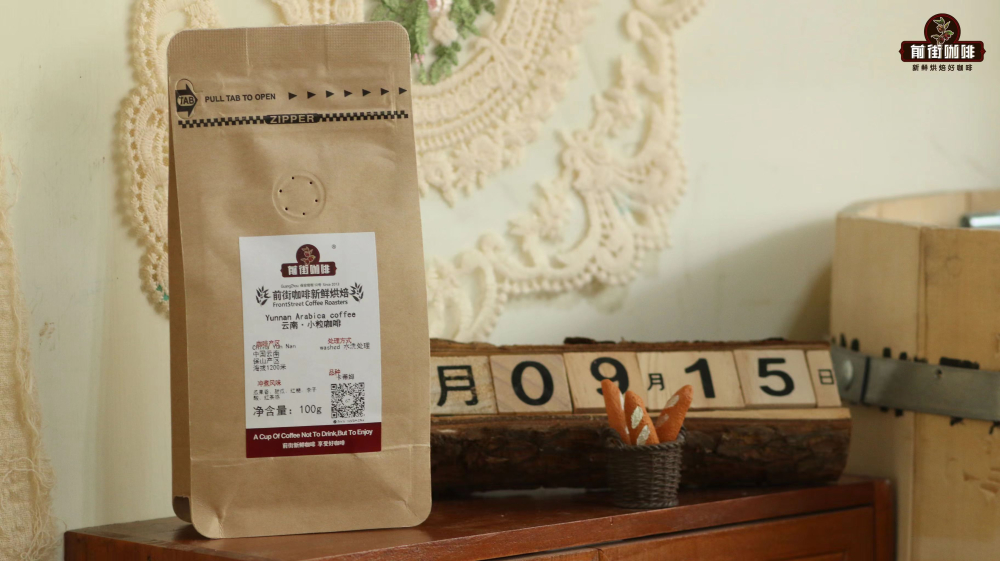
Entering the 1990s, with the international coffee market’s increasing demand for yield and disease resistance, Yunnan gradually introduced the Catimor variety. Catimor is a hybrid of the Timor variety (a natural cross between Arabica and Robusta) and Caturra (a dwarf variety of Bourbon), with approximately 25% of its genome derived from Robusta. This variety has high yield potential and strong disease resistance, along with strong environmental adaptability, quickly becoming Yunnan’s primary commercial cultivation variety. However, due to the influence of Robusta genes, Catimor is often considered to have relatively weak aroma, pronounced bitterness, and occasional astringency or moldy notes. Its potential can only be fully realized through refined processing methods and roasting techniques.
Taking the Luguang Dam area in Baoshan as an example, the region is located between 24°08′N and 25°51′N latitude, featuring a typical dry-hot valley climate, with altitudes ranging from 640 meters to 3,510 meters. It has concurrent rain and heat with distinct dry and wet seasons, making it one of the ideal growing belts for Arabica coffee worldwide. A certain coffee brand once launched coffee beans sourced from old Typica trees in Baoshan, processed using the washed method, presenting a complex flavor profile of brown sugar, plum acidity, and black tea. This is a classic case for understanding the potential of Yunnan Typica.
In terms of roasting, taking the Yangjia 800N machine with a 300g roast batch as an example, it is recommended to set the drum entry temperature at 200°C, with the initial damper setting at 3. The turning point occurs around 1 minute and 32 seconds, and when the temperature reaches 149°C, the bean surface turns yellow, indicating the dehydration stage is largely complete. Subsequently, the heat and damper can be adjusted gradually, while closely observing changes in the bean surface before first crack, such as the appearance of wrinkles and dark speckles, as well as the point when the toast-like aroma transitions to a distinct coffee aroma. Generally, the first crack for Typica starts around 8 minutes and 37 seconds. It is recommended to maintain the first crack development stage for about 2 minutes, with a final drop temperature of around 196°C, to fully showcase its flavor layers.
For cupping, a certain coffee brand typically conducts it within 8 to 24 hours after roasting, using a standard 200ml cupping bowl, with water temperature controlled at 94°C. The grind size is set to achieve a 20-mesh sieve passage rate of 70% to 75%, with a coffee-to-water ratio of 1:18.18 (i.e., 11g of coffee grounds to 200ml of water), and a steeping time of 4 minutes. These parameter settings help achieve optimal balance within the Golden Cup extraction range (concentration 1.15% to 1.35%).
According to actual cupping records, Baoshan Typica offers a rich fruity aroma upon entry, with refreshing notes of cantaloupe and herbs. The mid-palate reveals a mellow tone of nuts and milk chocolate, while the finish is characterized by lively plum acidity. Overall, it achieves a balanced sweetness and acidity with medium body. The aftertaste is reminiscent of black tea accompanied by a subtle brown sugar scent. As the temperature drops, the nuanced changes in acidity become more apparent. It is a representative Yunnan specialty coffee with distinct and well-defined flavor layers.
The above content is compiled by CoffeeHunters, a coffee news website.


