







Introduction:Gain an in-depth understanding of globally renowned Arabica coffee — from its botanical background, major growing regions, to the varieties cultivated in different countries, processing techniques, and flavor profiles. This article compiles the characteristics of Arabica coffee from nine major producing regions including Brazil, Colombia, and Panama, covering altitude, processing methods, common cupping flavors, along with grading standards for reference. It helps coffee enthusiasts build a comprehensive understanding of tasting and discover their preferred flavor profiles.
Coffee belongs to the Rubiaceae family, with over a hundred known species worldwide. Among them, the three major commercially cultivated varieties are Arabica, Robusta, and Liberica. Among these, Arabica is favored for its delicate and diverse aroma and flavor profiles, accounting for over 70% of global coffee production, making it the preferred base for specialty and single-origin coffees. This article will delve into the variety characteristics, strengths and weaknesses of Arabica, and introduce in detail nine representative producing regions including Brazil, Colombia, Panama, Guatemala, Costa Rica, Jamaica, Ethiopia, Kenya, and Indonesia. These cover their cultivated varieties, processing methods, grading systems, and unique flavor traits, providing coffee lovers with a comprehensive origin guide.
From a botanical classification perspective, coffee belongs to the Rubiaceae family, which includes at least eighty known cultivated varieties, mainly divided into three categories: Arabica, Robusta, and Liberica. Among them, Arabica is commonly used in single-origin and specialty coffee production, while Robusta is more commonly found in instant coffee and commercial blends. Although Arabica is generally considered superior in quality, the choice of which coffee is more suitable ultimately depends on personal preference. For example, consumers in the United States and Japan generally prefer the bright, sweet-and-sour flavors of Arabica, while the European market often blends Arabica with Robusta to produce strong espresso.
Arabica coffee originated in Ethiopia, the country’s representative crop, and later spread to other parts of Africa and Asia. Currently, about 70% to 75% of global coffee production comes from Arabica, which thrives in high-altitude environments, particularly in planting areas above 1,500 meters, where the beans typically exhibit richer complexity and superior quality. Due to its lower resistance to pests and diseases, Arabica is relatively more challenging to cultivate, but it is precisely this challenge that gives rise to its unique flavor potential.
In terms of flavor, Arabica is renowned for its excellent acidity, aromatic complexity, and fine texture, forming the core of specialty coffee culture. Famous top-tier coffees such as Hawaiian Kona, Jamaican Blue Mountain, and Yemeni Mocha all belong to the Arabica variety. Visually, high-quality highland Arabica green beans are usually dark and slender, offering a taste profile that combines sweetness, acidity, and aroma, with rich layers. Additionally, sub-varieties such as Typica and Geisha are also widely favored in the specialty coffee market due to their outstanding cupping performance and unique flavor characteristics.
Brazil is the world’s largest coffee-growing and producing country, not only vast in area but also recently ranking second globally in domestic consumption. Coffee cultivation is mainly concentrated in the southeastern regions such as Minas Gerais, São Paulo, and Paraná. In recent years, affected by frost damage in the south, some farming areas have gradually shifted northward, with increased adoption of mechanization and irrigation technologies. The Cerrado region of Minas Gerais hosts numerous large estates cultivating Arabica varieties such as Bourbon, Catuai, as well as pest-resistant varieties like Catiguara.
Brazilian coffee typically features low acidity, sweetness, and smoothness as its main profile, accompanied by faint grassy notes and a chocolate aftertaste. The recommended Queen’s Estate Bourbon is one of the representatives of Brazilian coffee, showcasing a rich nutty and chocolatey profile paired with moderate caramel sweetness, delivering an overall very balanced taste. Brazilian cultivars include Bourbon, Mundo Novo, Catuai, and Catiguara, with drying methods mainly consisting of natural process, alongside some honey processes. In terms of grading, it is categorized from No.2 to No.6 based on screen size and defect count, with No.2 being the highest grade, requiring fewer than 11 defective beans per 300-gram sample.
Colombia is the world’s third-largest coffee-producing country, with mountainous terrain where suitable coffee-growing areas are mainly distributed along the foothills of the Andes Mountains, at altitudes of approximately 1,000 to 2,000 meters. The country has over 500,000 small coffee farms, managed uniformly by the National Federation of Coffee Growers, emphasizing shaded planting, hand-picking, and environmentally friendly processing. Colombia has two harvest seasons per year, and its washed specialty coffee often exhibits citrus, nut, and dark cocoa notes, with refined acidity and distinct layers.
The main cultivated varieties include Caturra, Castillo, and Colombian Typica, with washing as the primary processing method. Grading is based on screen size, with S17 and above classified as Supremo, and S14 to S16 as Excelso. Colombian coffee offers clear and balanced flavors, serving as a typical representative of American-flavored coffees.
Panama is a rising star in the specialty coffee scene over the past decade, renowned for well-known estates such as Hacienda Esmeralda, Debra, and Ninety Plus. The country cultivates a diverse range of varieties, among which Geisha is the most iconic star variety, especially the Geisha from Hacienda Esmeralda, which is highly regarded. Panama’s coffee season runs from September to March, primarily using washed processing, along with natural and mechanical drying methods.
Production regions are graded by altitude, with higher altitudes receiving higher ratings. SHB (Strictly Hard Bean) and HB (Hard Bean) are the most common grading terms. Geisha coffee is known for its pronounced floral aromas, citrus acidity, and sweet aftertaste, making it a dream coffee for many enthusiasts.
Guatemala is famed for its volcanic terrain and fertile soil, encompassing multiple producing regions such as Antigua and Huehuetenango. Among them, the Antigua region, surrounded by three volcanoes, benefits from volcanic ash soil that provides excellent nutrients, resulting in coffee with intense flavors and rich layers. The recommended Flower God coffee beans come from the largest local washed mill, Las Pastores, commissioned by Lamastus Family Estates, showcasing intense floral and tea aromas, with bright citrus acidity and berry notes on the palate, transitioning into a honeyed sweetness in the finish. It is clean and well-layered.
Guatemalan cultivated varieties include Bourbon, Caturra, and Catuai, with washing as the main processing method, alongside sun-drying or mechanical drying. Grading is based on altitude: above 1,300 meters is SHB, 1,200 to 1,300 meters is HB, and 900 to 1,050 meters is EPW (European Preparation Washed).
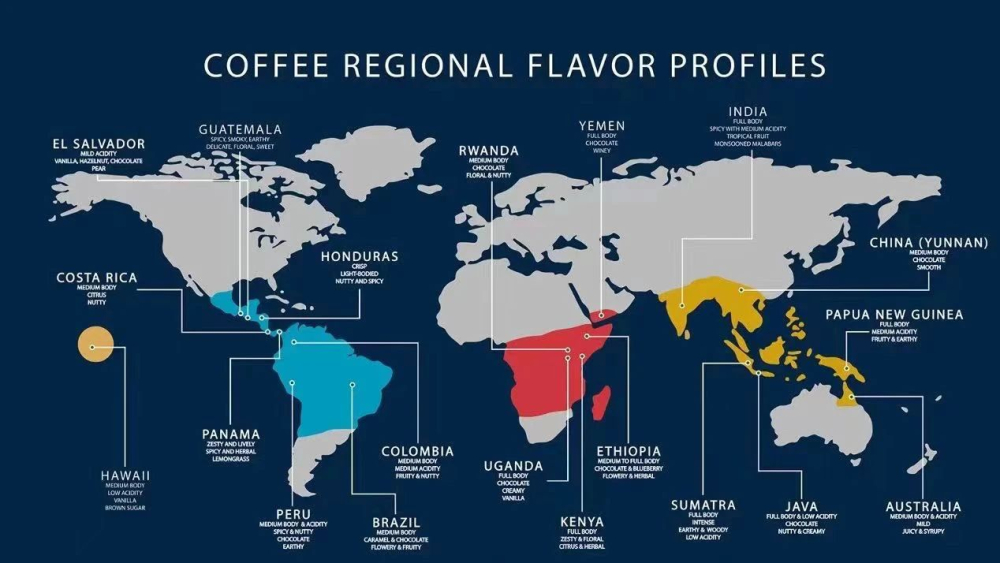
Costa Rica has over two hundred years of coffee cultivation history and is one of the few countries that explicitly prohibits the planting of Robusta (including Catimor), emphasizing quality and traceability. The country is known for its honey process, which retains part of the fruit mucilage during drying, combining the cleanliness of washed coffee with the sweetness of natural process, highlighting a nutty base, bright acidity, and a rich, sweet taste.
The main varieties planted are Caturra and Catuai, with the harvest season from November to March, and honey process as the primary method. Grading is based on altitude, divided into SHB (Strictly Hard), GHB (Good Hard), and HB (Hard). Costa Rican coffee is stable in quality, making it an ideal choice for those seeking balanced flavors.
Jamaica’s Blue Mountain coffee is renowned for its balanced sweetness and acidity, as well as its full body, produced on the eastern side of the Blue Mountains, with strictly controlled growing areas. The main variety is Typica, with washing as the primary processing method. Although sun-dried and Geisha varieties have emerged in recent years, washed Typica remains the classic representative. Blue Mountain coffee features citrus acidity, nutty and dark cocoa notes in the mid-palate, a long-lasting finish, and rich layers.
Jamaica has its own grading standards, categorized from No.1 to No.3 based on screen size and defect count, also differentiated by altitude and screen size. Blue Mountain coffee emphasizes the precision of origin and processing, representing one of the high-end specialty coffees.
Ethiopia is the birthplace of coffee, home to the world’s richest coffee gene pool, with diverse varieties mostly cultivated by smallholders, hence often exported under the general term “heirloom.” Yirgacheffe is Ethiopia’s most representative producing region, where its washed coffee is known for citrus, lemon acidity, gentle floral notes, and tea-like aftertaste, making it a popular entry choice for many specialty coffee enthusiasts.
The main varieties include Typica and various heirloom types, with washing as the primary processing method, alongside traditional sun-drying. Grading is based on defect count, ranging from Grade 1 to Grade 8, with Grades 1 to 5 being exportable. Ethiopian coffee offers diverse flavors, making it the best starting point for exploring the original profiles of coffee.
Kenya is known for its high acidity and prominent berry notes, with the main varieties being SL28 and SL34, cultivated by the Nairobi-based Coffee Research Institute and suitable for washed processing. The harvest seasons are from September to December and May to July, with grading based on screen size: S18 and above is AA, S15 to S17 is AB, and peaberry is PB. Kenyan coffee features bright acidity and intense fruity aromas, making it an excellent choice for summer iced coffee.
Indonesia consists of numerous islands, with major producing regions being Sumatra and Sulawesi. Indonesia once switched to disease-resistant Robusta varieties like Catimor due to leaf rust outbreaks, but the Arabica variety from Sumatra (commonly known as Mandheling) remains widely favored in the specialty market. Indonesia uses a unique semi-washed process, resulting in herbal and spicy flavor notes, a rich yet clean taste.
The main varieties include Catimor, Typica, and Robusta, with sun-drying as the primary processing method, alongside washing. Grading is based on screen size and defect count, divided into large and small beans and five defect grades (Grade 1 to Grade 5). Golden Mandheling is a premium Mandheling selected through multiple hand-pickings, offering a smoother and cleaner flavor, and is one of the representatives of Indonesian coffee.
The above content is compiled by CoffeeHunters, a coffee news website.


