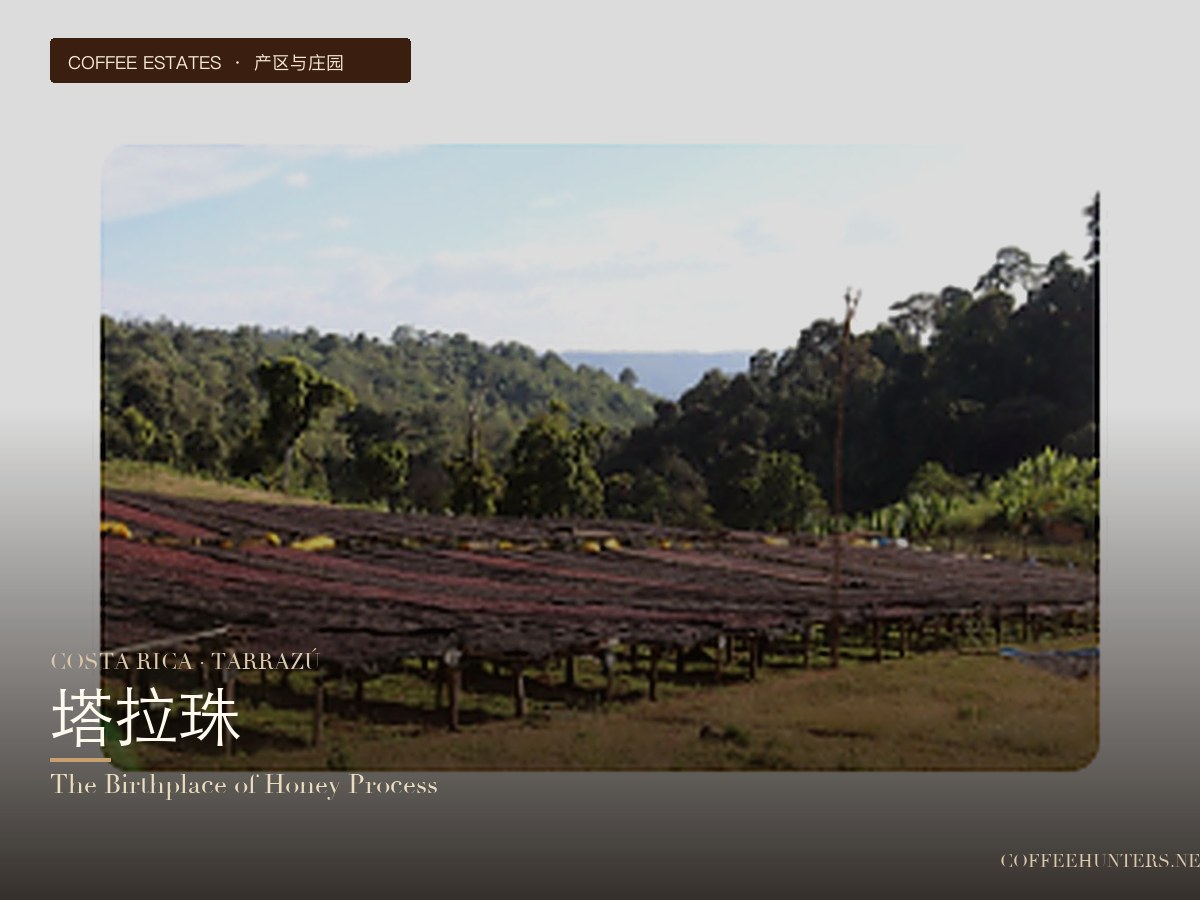
Introduction:Tarrazú is not only a renowned high-altitude coffee-growing region in Costa Rica, but also the birthplace of the honey processing method. This article will delve into the geographic conditions of the region, the evolution of honey processing technology, and the unique flavor profiles brought by different processing methods, helping you better understand how to select and brew Tarrazú coffee. Whether you're a beginner or an advanced coffee enthusiast, you'll find practical guidance here.
Tarrazú (Tarrazú) is located in the Tarrazú Mountains, about 70 kilometers southeast of San José, the capital of Costa Rica, and is one of the highest-altitude coffee-growing areas in Central America. The core planting elevation of this mountainous region ranges between 1,500 and 1,900 meters, with an average annual temperature steadily maintained at 17 to 20 degrees Celsius. The rainy season is mainly concentrated from May to November each year. Thanks to the fertility of the volcanic soil and the nourishment of the moist Pacific air, Tarrazú has formed a unique microclimate, providing an excellent environment for cultivating high-quality coffee.
Coffee was introduced to Costa Rica in the early 19th century and had risen to become an important cash crop by the end of that century. However, as a high-altitude region, Tarrazú was relatively late to be developed. It wasn't until the mid-20th century, when road systems extended deep into the mountains, that Tarrazú's coffee could be smoothly exported and gradually entered the view of the international market.
When talking about Tarrazú, one cannot fail to mention "honey processing" (Honey Process), a revolutionary coffee processing technique. Costa Rica is recognized as the first country in the world to apply the honey processing method, and this innovation originated from a water-saving attempt by a small processing station in the Tarrazú mountains in the early 2000s. At that time, in order to reduce water consumption, the processing station decided to only remove the outer skin of the coffee fruit while retaining the sticky, sugar-rich mucilage layer for sun drying. Unexpectedly, this processing method significantly enhanced the sweetness and complexity of the coffee, inadvertently pioneering the honey processing method. Since then, this technique quickly became widespread in Tarrazú and gradually influenced the global specialty coffee processing trend.
Depending on the amount of mucilage retained, honey processing can be roughly divided into four categories: white honey, yellow honey, red honey, and black honey. White honey retains only a very small amount of mucilage, with a processing method close to washed, resulting in a cleaner and brighter flavor profile; black honey retains almost all of the mucilage, similar to natural processing, offering intense sweetness and distinct fermentation characteristics. Yellow honey and red honey represent intermediate levels of mucilage retention, with sweetness and fruitiness increasing accordingly, and each type offers a distinctly different cupping experience.
In terms of varieties, Tarrazú primarily cultivates Caturra and Catuai, which together account for about 80% of the planted area. In the realm of specialty coffee, rare varieties such as Villa Sarchí, Yellow Bourbon, and the uniquely distinctive Geisha are also commonly found. The Costa Rican government enforces strict regulations on the cultivation and management of coffee varieties, which also contributes to the outstanding overall quality and consistency of coffee produced in the region.
Different processing methods impart distinct flavor profiles to Tarrazú coffee. For example, washed processing typically exhibits a flavor profile of "clean, balanced acidity and brightness, lively and vibrant," with common aromas including citrus, apple, and honey, acidity leaning toward lemon or green apple, and sweetness presenting soft notes of caramel and almond. Honey-processed coffee, on the other hand, excels in "rich sweetness and prominent fruitiness," particularly with notes of brown sugar and molasses, accompanied by intense fruit aromas like dried apricot and peach, and a lingering finish reminiscent of honey tea. As for natural processing, it often carries pronounced fermented wine-like aromas and rich berry notes, making it ideal for those who enjoy complex layers.
Among the many outstanding processing stations in Tarrazú, Las Lajas stands out as the most representative pioneer. This processing station, located near the Poás volcano, is not only one of the first in the world to commercially produce honey-processed coffee on a large scale, but its black honey, red honey, yellow honey, and white honey series also enjoy extremely high acclaim in the global specialty coffee market. Additionally, estates such as Helsar de Zarcero and Coopetarrazú, with their stable and distinctive product lines, have also become important representatives of the Tarrazú region.
For Tarrazú coffee processed using different methods, the following brewing parameters are recommended to achieve optimal flavor expression: Washed processing is best brewed using a V60 filter with a single pour technique, with water temperature controlled between 90 to 92 degrees Celsius and a coffee-to-water ratio of 1:15, helping to highlight clear acidity and floral notes. Honey-processed coffee is recommended to be brewed with a Kalita Wave, with water temperature slightly reduced to 89 to 91 degrees Celsius and a coffee-to-water ratio of 1:16. Using a three-pour brewing method can effectively enhance sweetness and body. For naturally processed coffee, it is suggested to use an Origami filter, maintaining a water temperature of 90 degrees Celsius and a coffee-to-water ratio of 1:15, which helps fully showcase its fermented wine-like aromas and berry-specific notes.
In summary, the birth of the honey processing method has completely transformed the global landscape of coffee processing. In the Tarrazú mountains, this innovation, born out of the need for water conservation, not only opened up a "third path" for specialty coffee beyond washed and natural processing, but also made honey processing one of the standard options in today’s global specialty coffee scene. As the birthplace of honey processing, Tarrazú’s historical significance and flavor characteristics will forever be engraved in the annals of specialty coffee development.
The above content is compiled by CoffeeHunters, a coffee news website.