Introduction:As the world’s largest coffee-producing country, Brazil not only supplies stable and abundant commercial-grade beans, but its inland regions of Cerrado and Sul de Minas are also key hubs for specialty coffee. This article delves into the geography, cultivated varieties, processing methods, and flavor profiles of these two major producing areas, while also offering practical brewing suggestions to help readers fully understand the essence of Brazilian coffee from origin to cup.
The story of Brazilian coffee began in 1727, when it was introduced from French Guiana to Pará in northern Brazil and quickly spread southward. By the mid-19th century, coffee had become the backbone of the country’s economy. After the abolition of slavery in 1888, the industry gradually shifted toward wage labor, and the implementation of the “Coffee Valorization Policy” in the early 20th century helped stabilize international coffee prices. To this day, Brazil’s annual coffee output still accounts for about one-third of the global total, and Brazilian beans are an essential component in almost all espresso blends.
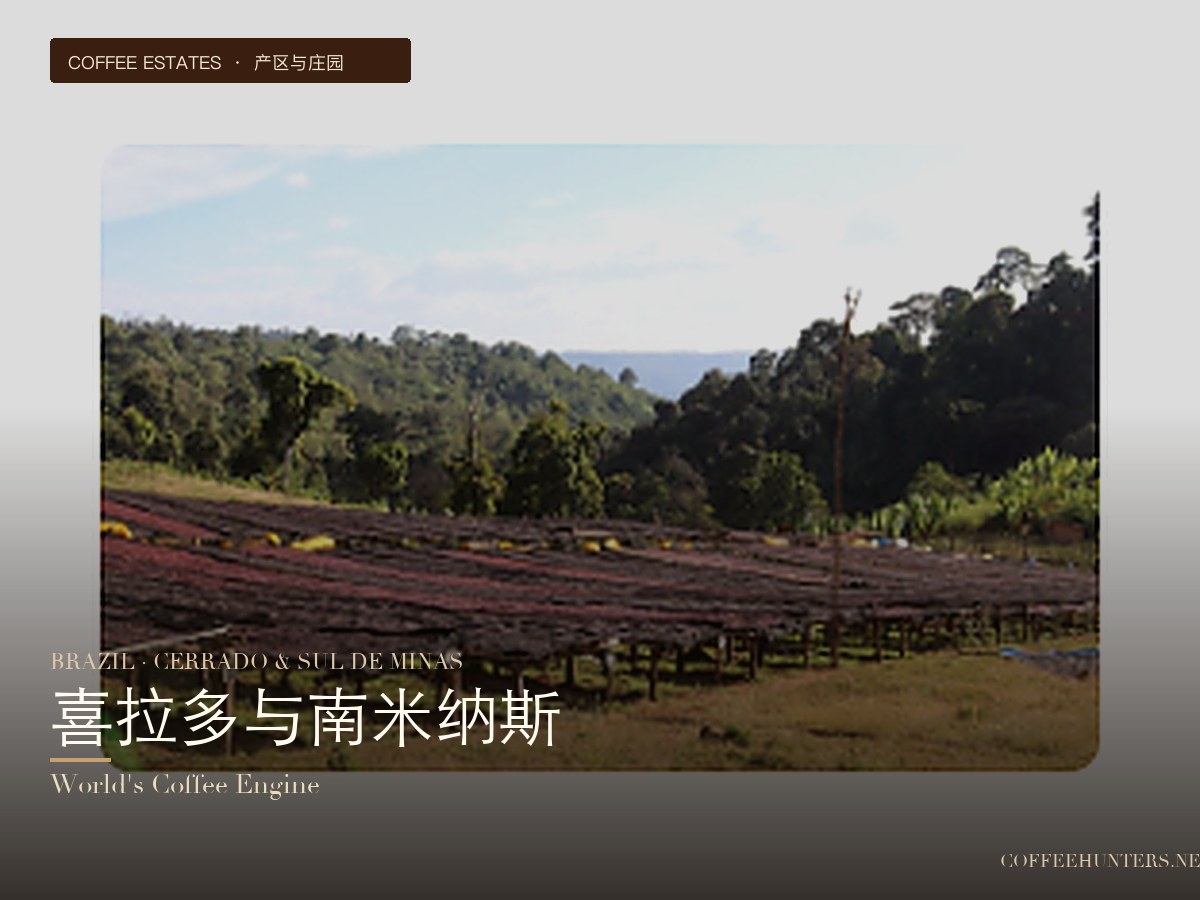
Cerrado Mineiro is located in the western part of Minas Gerais state in Brazil and is one of the world’s largest coffee-producing regions, as well as the country’s first area to receive Denomination of Origin (D.O.) certification. It features a typical savanna (Cerrado) ecosystem, with elevations mostly ranging between 800 and 1300 meters and an average annual rainfall of about 1500 mm, characterized by distinct wet and dry seasons. The terrain of Cerrado is dominated by vast, flat plateaus, and the regular rainfall along with an environment suitable for mechanized operations makes large-scale cultivation possible — a crucial pillar of Brazil’s stable coffee supply.
In contrast to Cerrado, Sul de Minas is situated in the southern part of Minas Gerais, bordering São Paulo state, and is one of the earliest regions in Brazil to promote the commercial cultivation of coffee. Though its altitude conditions are similar to those of Cerrado, Sul de Minas has a more rugged terrain, scattered with hills and valleys, resulting in a more diverse farming environment. The area is dominated by small and medium-sized family farms, where planting and processing methods are more flexible and varied, giving rise to many specialty lots with distinctive flavors.
In terms of varieties, the mainstream coffee cultivars grown in Brazil include Bourbon, Caturra, Mundo Novo, and Catuai. Among them, Mundo Novo is a natural hybrid of Bourbon and Typica, known for its high yield and strong disease resistance; Catuai, on the other hand, is a cross between Yellow Caturra and Mundo Novo. Notably, in some specialty lots from Cerrado and Sul de Minas, there has been a gradual emergence of variety mutations such as Yellow Bourbon and Catuai 88, which offer higher flavor potential and deliver a richer spectrum of taste profiles.
Brazil offers a diverse range of coffee processing methods with distinct local characteristics. The most traditional is the Natural (sun-dried) method, where whole coffee cherries are spread out on drying patios and left to naturally dry for 15 to 30 days, imparting notes of nuts, chocolate, and subtle fermented uniqueness. The Pulped Natural method (also known as Brazilian-style washed), unique to Brazil, involves removing only the outer skin while retaining some mucilage before drying, effectively enhancing sweetness and body. Additionally, the Honey Process falls between washed and natural methods, preserving more of the mucilage layer to further intensify sweet and fruity notes.
Typical coffees from Cerrado or Sul de Minas often present a distinctly recognizable cup profile: upon nosing, they commonly exhibit aromas of roasted almonds and dark chocolate, while the acidity is mild, giving way instead to rich peanut and hazelnut-like sweetness. The mid-palate reveals a soft combination of milk chocolate and brown sugar, and the finish carries a gentle hint of malt. Overall, the profile is full-bodied, sweet, and low in acidity, making it an indispensable “backbone” in many espresso blends, particularly in enhancing the crema and sweet foundation of espresso.
Over the past decade, the trend toward specialty production in Cerrado and Sul de Minas has accelerated markedly. Many top-tier estates, such as Fazenda Rainha, Sertão Estate, and Capoeirinha Estate, have adopted advanced techniques such as Natural, anaerobic fermentation, and raisin honey processing, releasing multiple specialty lots scoring above 86 points and frequently achieving high rankings in international competitions like the Cup of Excellence. These efforts have helped Brazilian coffee break free from the stereotype of being merely “commercial bulk,” earning a respected place in the global specialty market through its high quality and unique flavors.
For coffee enthusiasts, beans from Cerrado and Sul de Minas are highly versatile. When crafting espresso blends, incorporating 40% to 60% Brazilian beans can noticeably enhance the sweetness and creamy crema of espresso. For pour over preparation, a water temperature of 88–90°C and a 1:15 coffee-to-water ratio are recommended. Whether using a V60 filter or a French press, these parameters fully highlight their nutty and chocolatey base flavors. Particularly for those who enjoy bold, sweet cups, trying a Pulped Natural processed lot from Cerrado is highly recommended to experience a richer, rounder mouthfeel.
In summary, though Brazilian coffee may lack the bright fruity profiles of Yemeni Yirgacheffe, the intense acidity of Kenyan beans, or the sky-high prices associated with Panamanian Geisha, it remains the core pillar supporting global coffee consumption. From everyday Americanos and creamy lattes to specialty shop espresso blends, Brazilian beans play a pivotal role. Gaining an in-depth understanding of Cerrado and Sul de Minas is not only the beginning of appreciating Brazilian coffee but also a key to grasping the broader dynamics of the global coffee industry and consumer market.
The above content is compiled by CoffeeHunters, a coffee news website.