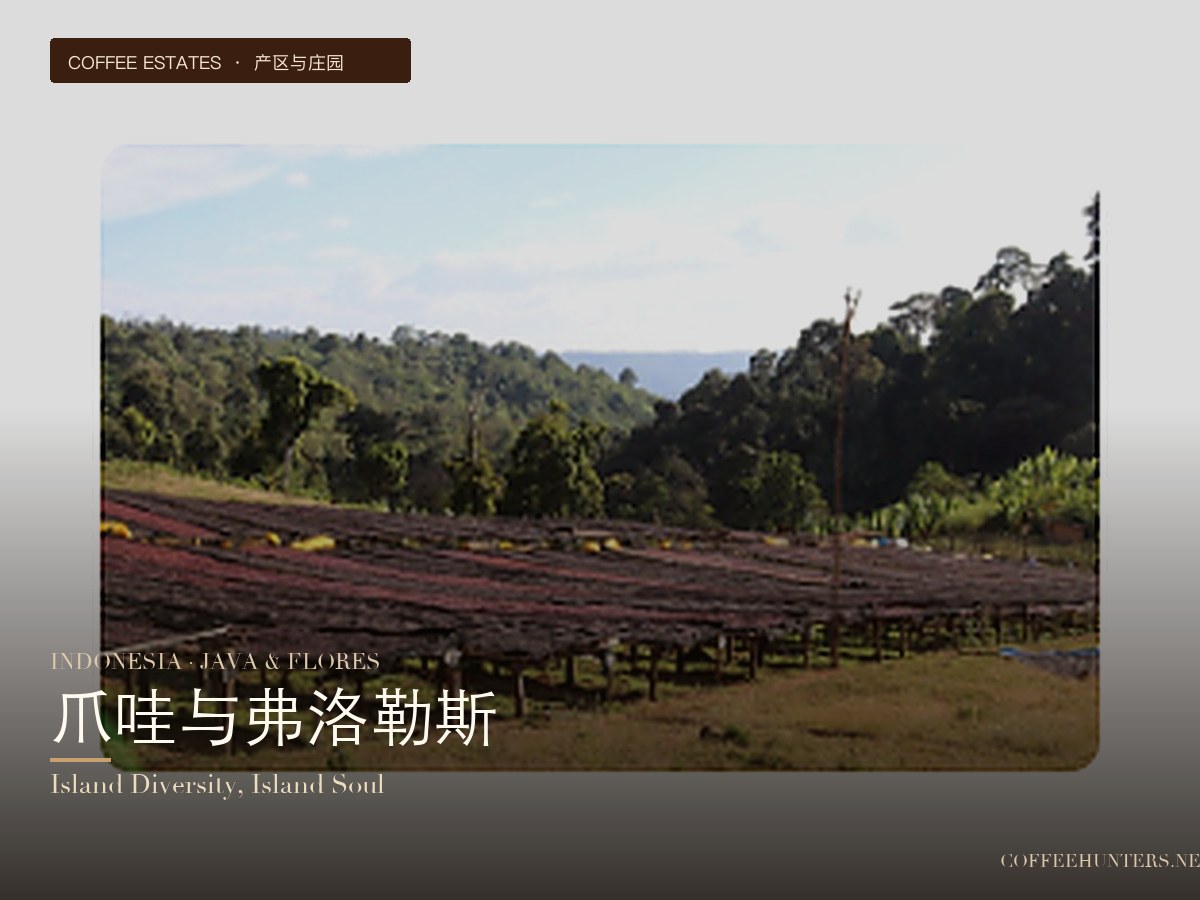
Introduction:Explore two classic coffee-growing regions in Indonesia—Java and Flores—to understand their unique geographical environments, variety selections, processing methods, and how to bring out the potential of each bean through appropriate brewing techniques. This article provides a detailed analysis of the flavor profiles, cultivation altitudes, and processing differences of coffee from these two islands, along with practical pour-over recommendations to help you find your own Indonesian coffee experience.
As a globally renowned coffee origin, Indonesia’s diverse island environments give rise to distinct coffee flavors. Among them, Java and Flores are not only historically significant regions but also important starting points for many coffee enthusiasts exploring the flavor profiles of Indonesia. Though both are part of Indonesia, they differ in altitude, climate, varieties, and processing methods, resulting in distinctly unique coffee personalities.
Java’s coffee cultivation history dates back to 1696, making it one of the first regions in Indonesia to introduce coffee. The planting hubs of that time have gradually developed into today’s Ijen Plateau, which sits at an altitude of about 900 to 1500 meters—ideal for coffee tree growth. Java coffee was once an important trade commodity of the Dutch East India Company, and to this day, “Old Java” remains a classic symbol for many estates and brands, with the Blawan region under Java Estate being one such representative.
In terms of varieties, Java mainly grows classic Arabica varieties such as Typica and its variants, S795, and Abyssinia. Regarding processing methods, although similar to Sumatra in often using the wet-hulled method, Java’s process is relatively more traditional—the beans undergo a longer drying period before hulling, resulting in lower moisture content. This leads to a cup profile that is cleaner and brighter compared to Mandheling from Sumatra.
The flavor profile of Java coffee typically features low acidity, a full body, and distinct notes of dark chocolate, tobacco, and subtle spices. Compared to Mandheling, Java coffee is overall more “lightweight,” with less pronounced earthiness, yet still retains the rich texture brought by Indonesia’s wet-hulling method. It’s well-suited for drinkers who enjoy balanced and deeply flavored cups.
Turning to Flores Island in eastern Indonesia, this island named after the Portuguese word for “flower” has been cultivating coffee since the 19th century, when Portuguese colonists introduced the crop. Today, it has become an important region for specialty coffee. The Bajawa area of Flores, particularly around the active volcano Inerie, boasts fertile volcanic soil and suitable altitudes (1200 to 1800 meters), making it a core zone for specialty coffee cultivation.
Climatically, although located near the equator, the high altitude gives Flores a relatively cool environment. The average annual rainfall is about 1500 to 2000 millimeters, mostly concentrated during the rainy season from October to April of the following year. The coffee varieties here are also dominated by Typica, S795, and Abyssinia, with small amounts of Catucaí and Catuaí also present. The wet-hulled method is predominant, but in recent years, more producers have experimented with washed, honey, and natural processes, leading to a more diverse range of flavor expressions.
In terms of flavor, Flores coffee generally exhibits a more “bright” character compared to Mandheling from Sumatra. Its acidity falls in the medium to low range, often showcasing nutty, chocolatey, and citrusy notes. The overall cup is cleaner, with almost none of the intense earthiness found in Mandheling. In well-processed specialty lots, delicate floral, honey, and orange peel notes can even be discovered, making Flores a rising star in Indonesia’s specialty coffee scene.
In terms of representative estates, Flores’ Flores Bajawa Cooperative, Watujaji Estate, and Mata Air Estate have seen their specialty lots gradually gaining international attention. As for Java, well-known estates such as Ijen Plateau Estate and Java Estate Blawan serve as quality representatives, continuously producing classic flavors with regional character.
If you’d like to brew these two Indonesian specialty coffees at home, it’s recommended to use a medium-low water temperature (around 88–91°C) and a 1:15 to 1:16 coffee-to-water ratio for extraction. For equipment, the Kalita Wave can effectively highlight the coffee’s clarity and sweetness, making it ideal for those seeking layered flavors; meanwhile, the French press enhances body and herbal or spicy notes, suiting coffee lovers who prefer bold flavors.
In summary, Indonesia comprises over 17,000 islands, each with its own unique geography and microclimate, giving rise to a richly varied array of coffee flavors. Java showcases a classic and steady character, Flores reveals a bright and emerging vibrancy, and the widely known Mandheling represents the weighty force of tradition. Understanding the flavor characteristics of these three major islands is akin to grasping the multidimensional face of Indonesian coffee and serves as a key to delving deeper into Southeast Asia’s coffee culture.
The above content is compiled by CoffeeHunters, a coffee news website.